


I’m ashamed to admit I was victim to one too many April 1st scams —I really believed that Matthieu Blazy was being ousted from Chanel by a Karl Lagerfeld AI. On a day when the writing is on the wall, it’s worrisome that I (and so many of my peers) still fell for cheap tricks and clickbait.
We’re constantly trying to decipher what’s AI-generated and what’s not. We’re not sure if half the things we read online is true. In a moment when “seeing is believing” takes on a new meaning, being able to critically examine what we’re looking at is key.
But how? Art historians seem to have an answer.
Contrary to popular belief, there are strict steps that every coherent art criticism must follow. The Art History “method” helps you break down what you see before trying to understand it —like taking apart an engine and putting it back together.
This approach is so effective, that more than 100 U.S. medical schools today partner with art museums to offer art-based courses on diagnosis.1 Over the past year, Harvard Medical School reported a ~20% increase in observational accuracy from these courses. Susan Sontag argues that “perception is not passive” in her book On Photography. I believe Art History is the discipline that teaches us how to actively perceive.

Art History has been broadly represented as the evolution of visual culture. But to me, the crux of the multi-century old discipline lies in how it’s formalized the act of looking.
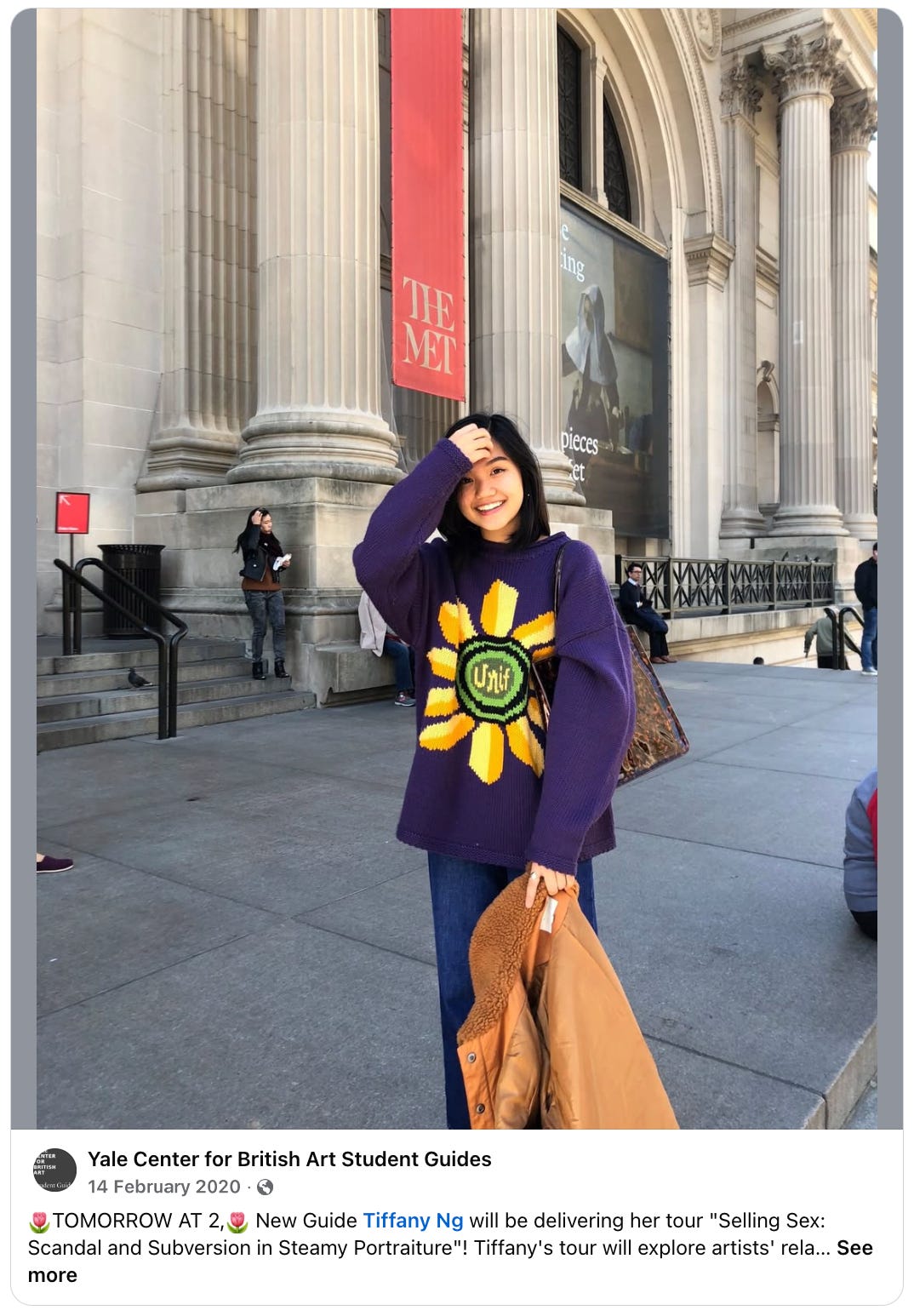
When I graduated with a double major in Ethics, Politics & Economics2 and Art History, I was asked to choose one to print on my diploma. Yale had decided that two majors would be a mouthful so, at the behest of my mother, I left Art History out. Ever since, I’ve mostly introduced myself as a political philosophy major. Why? Did I somehow think my Art History was frivolous?
For how archaic and impractical the discipline appears to be, Art History is the punchline to most jokes about academia.3 Who gives a sh*t about whether this pot was a cerulean or aquamarine blue? Why does it matter that this 18th century pot was made to slightly tilt to the left? We over index on the subject of the discipline, such that we overlook the soft skills that studying Art History offers.
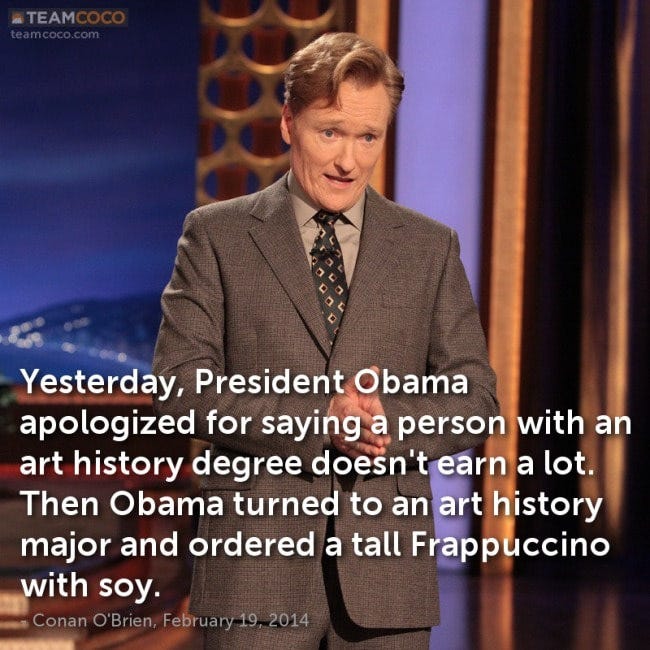
In a moment where more “hard skills” are subject to automation, soft skills are exponentially appreciating in value. The Atlantic agrees. As of August of 2025, art history majors had twice the employment rate than their computer science counterparts. 4
Could Art History end up being the most employable major?
*** I did attend a “what to do with your art history degree seminar in my senior year. Every alumni who spoke worked in management consulting…
The art of looking
In the few years I spent writing my thesis and working as a gallery guide, I had to roughly follow the same three steps for each work I studied:
Visual analysis: without researching the piece, write a description of exactly what you see —colors, lines, shapes, composition— without drawing conclusions of what they may be. This is your first impression of the work.
Research and contextual analysis: survey existing literature and information about the piece. How does your first impression of the piece relate to its context?
Argumentative assessment: based on what I know, connect the dots between my observations to make claims and form an opinion. Do you like it? Why? Why not?
In “real life,” we often jump straight to the last step. We see something, make an inference, and immediately form an opinion. A Peabody Essex Museum study found the average person spends 17 seconds with a work of art before moving on —a lifetime compared to the 1.5 seconds people give a TikTok or Reel. There’s no room for critical thinking. Our speed of consumption makes us jump to conclusions.
By forcing us to sit with a visual and clearly articulate why we think we’re seeing what we’re seeing, the Art History method pokes holes in our inferences. It nudges us to evaluate our biases because, most of the time, we’re looking. Not seeing.
Rule 1: Separate observation from inference
There’s a difference between what you observe and what you infer. At first glance, several thoughts run through our minds when we look at something. It’s important we break those thoughts down. Take for example…
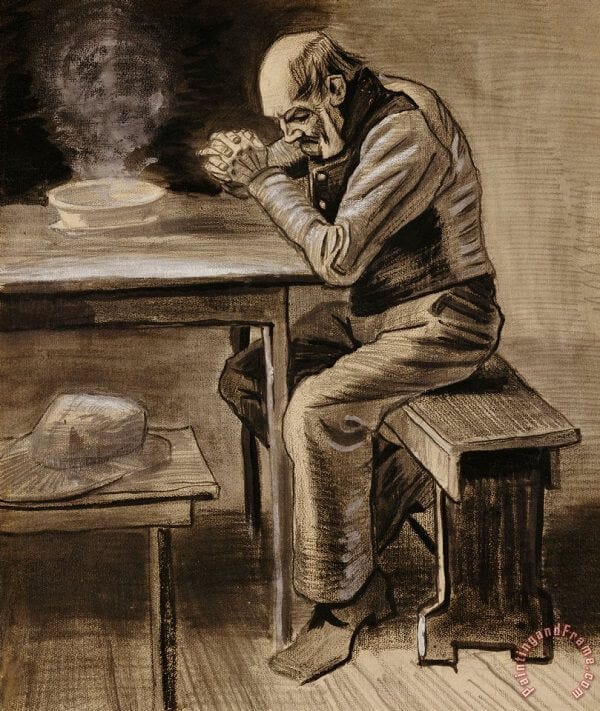
Observation — “the figure’s hands are clasped”
Inference — “the figure is praying”
The first step of visual analysis asks us to consider all these possibilities and identify what can be objectively said about an image: not everyone would see this figure’s clasped hands as a prayer. He could be clenching from anger or deep introspection. The composition makes him look like he’s sitting alone, but can we be so sure? Are his eyes closed or is he just looking down?
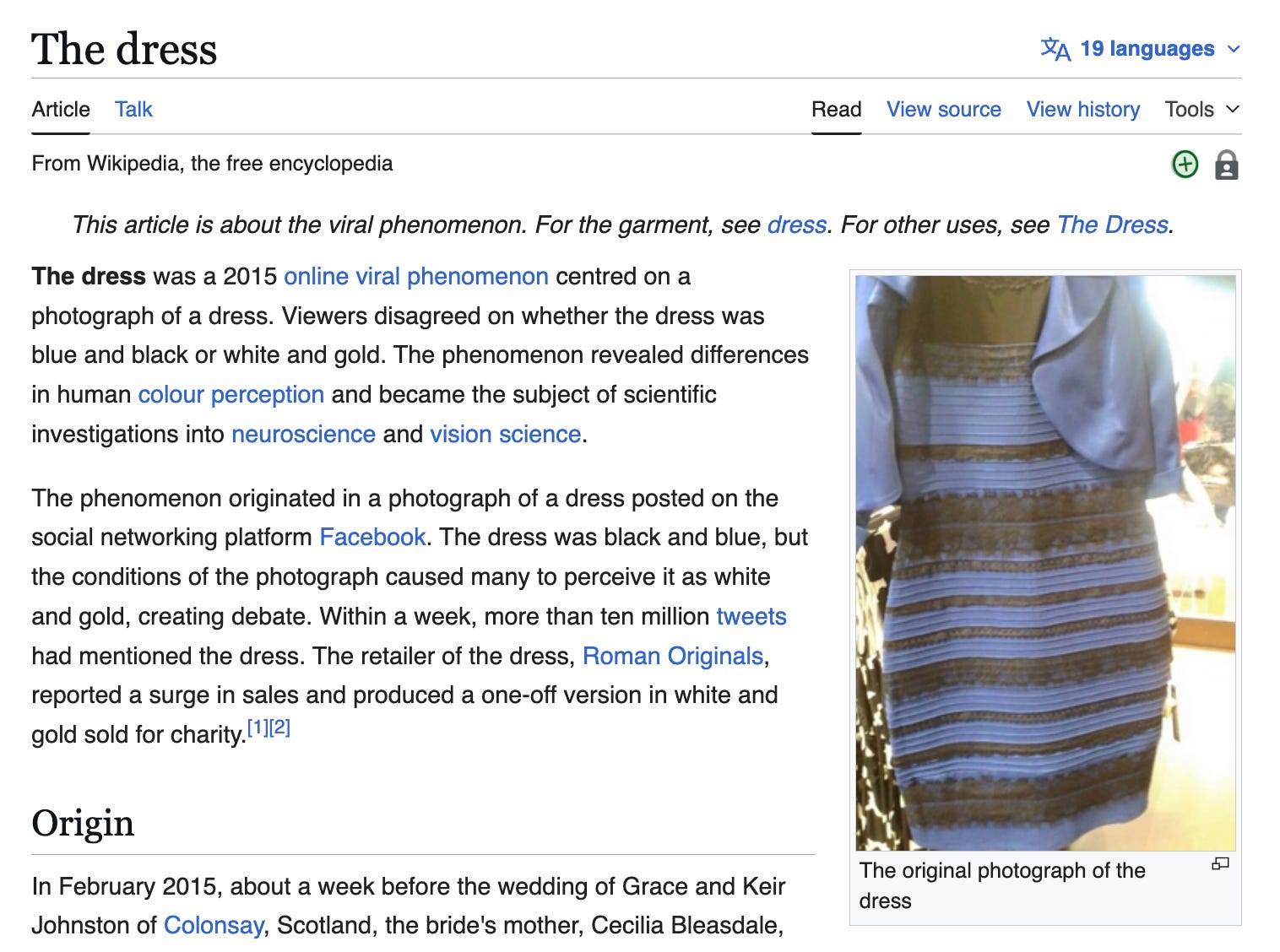
In the age of social media, we’ve normalized closing the gap between inference and observation. Everything is taken for face value, so when there’s disagreement in interpretation, we brush it off as a difference of opinion. Ask yourself — how would you describe this visual to someone who can’t see it? How would their perspective change your description?
Separating observation from inference helps us outline the common denominator of what we see online. Ignorance to dissent is what drives polarization.
Rule 2: Examine the architecture of meaning
Having sterilized our observations, putting the pieces back together to re-construct our first impression of the work helps us understand why we think the way we do.
Cultural symbols and social/institutional consensus interact discursively to consecrate meaning on anything we see: we put more weight on headlines we see on the front page of the Times. We read text printed on images as fact. The structure of a composition shapes its message, and it’s the art historian’s job to re-draw the blueprint of its architecture.
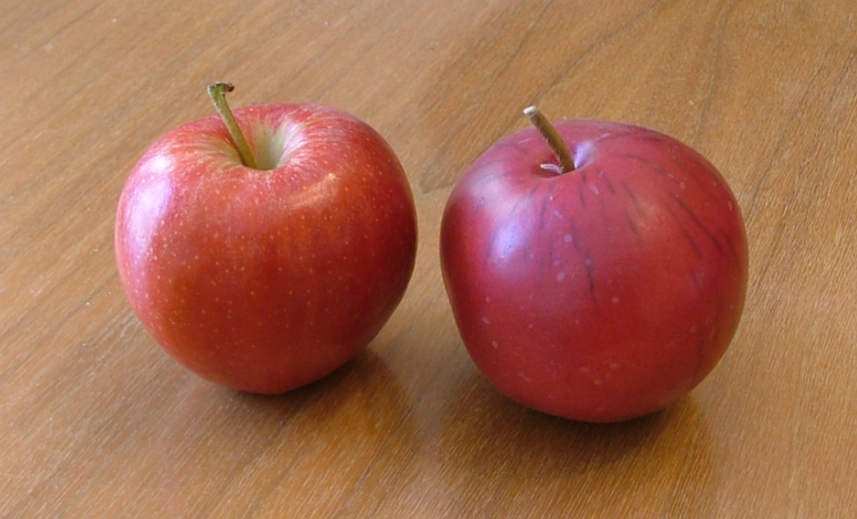
Is this visual subverting an established format?
What’s something you expected that is absent from this visual?
How does meaning change when you move components around?
Most art historians would agree that there isn’t always an intrinsic meaning in what we observe. Instead, it’s the relationship that each observation has with one another that meaning arises: clasped hands next to a crucifix implies prayer.
German art historian Erwin Panofsky wrote extensively about iconology, arguing that cultural systems are the purveyors of meaning. He believed, to the extent that a lily would be interpreted as a symbol of purity only to a medieval Christian viewer, objects aren’t the carriers of meaning. Their contexts are.
Rule 3: Consider multiple perspectives
Bait, of the rage or click-farming variety, implies exploitation. Someone wants something from someone. How does the message change with these intentions?

We’ve seen people print misleading headlines, intentional misspell words, and strategically edit video loops to farm for engagement. So we’re more capable of distilling what their messages are without being taken advantage of.
Anthropic’s constitution accounts for this. When users submit a prompt, Claude tempers its response with the context of this request and what it knows about the user. It considers the many perspectives its user may have when asking for what the user actually wants.
Same goes with Art History. We know that history is written by winners, so it’s important to consider the motivations behind any work of art:
Who’s produced this?
In what context were they producing this?
Who is it for?
What does the creator of this want?
Linda Nochlin’s famous 1971 ARTnews essay Why Have There Been No Great Women Artists? pushed the art world to consider the institutional barriers that inhibited the careers of female artists. She called into question the assumption that great women artists didn’t exist —not that they were underrepresented. When history is only written by winners, so how do fragments of truth get buried?
At the very least, ask yourself why
There doesn’t seem to be much time for introspection these days. We make split-second inferences on what we see and move on. But when we talk about AI eroding critical thinking, we don’t talk much about what critical thinking actually looks like.
I’m hoping that this overview of the art history method could be a start.

It’s difficult to blame people for believing what they’re seeing when videos of bunnies jumping on a trampoline go viral for flying under AI-generated-radar and AI musicians sound eerily realistic. But I do believe that slowing down and asking yourself why has become more important than ever.
Hello friends! I enabled paid subscriptions to support some of my more rogue ventures in cyber celibacy (typewriters, building a printing press… more to come).
I also created a Snail Mail Membership, where (in true neo-luddite fashion) I’ll physically mail you this newsletter on a bi-monthly basis. For the first dozen snail mail members, I’ll handwrite your first letter <3
For the 2025-2026 academic year, Harvard Medical School partnered with Boston’s Museum of Fine Arts and UPenn’s School of Medicine partnered with the Philadelphia Museum of Art to launch visual diagnostic programs. Other medical schools, including Yale, Columbia, Stanford, and Cornell have also followed suit. All these programs follow findings from several published papers on the efficacy of art history methodologies in diagnosis.
Yes this is a single major and it’s a mouthful
I’ve always loved that one Brooklyn99 scene where Sterling K. Brown argues with Captain Holt over whether PhDs are doctors. He says something to the effect of: “when someone’s dying on a plane, would you go, does anyone have an Art History PhD?!”
I have repeated this stat more times than I’d like to admit
I found this properly fascinating. I'm ashamed to say I know very little about art appreciation and this inspired me to investigate. As you say, for those trying to rebuild their critical thinking after tech overdose, worth knowing what that critical thinking actually is.
Great piece.