


What if we could physically retrace our digital footsteps? We already “visit” websites and enter URLs as “addresses.”
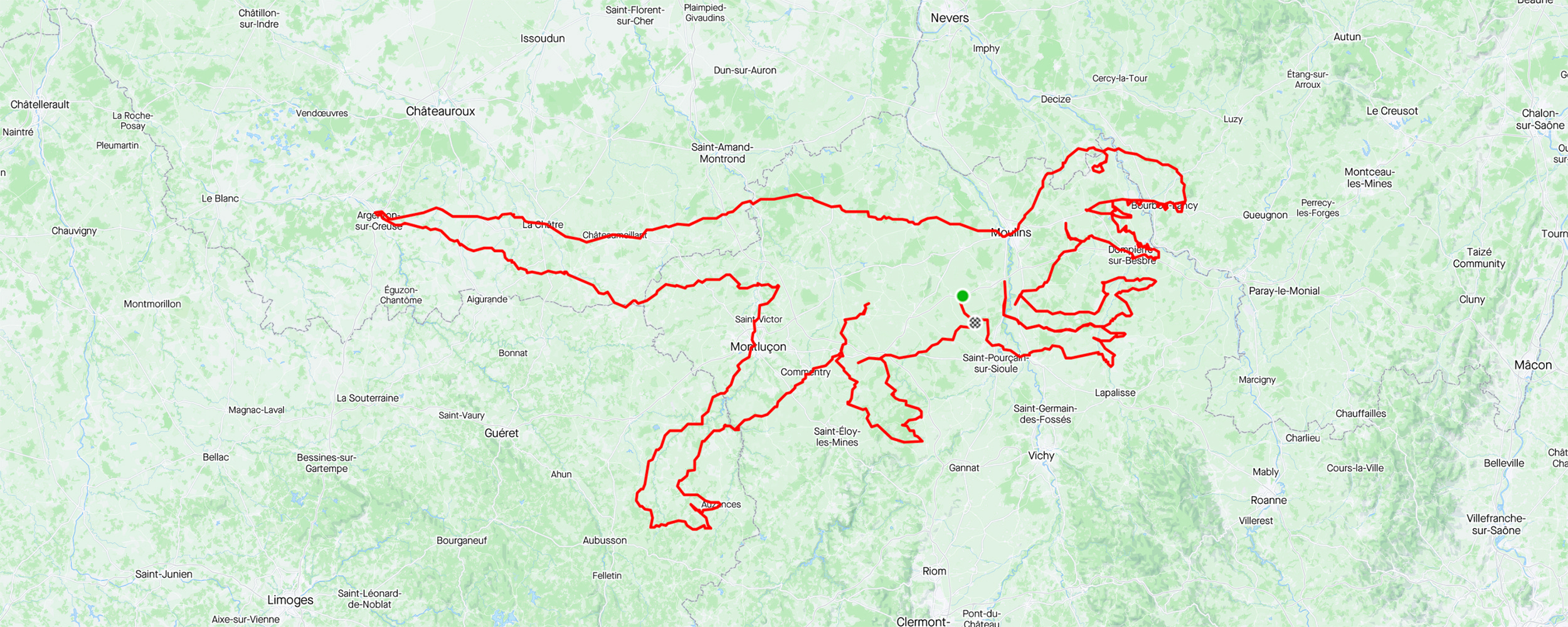
Like the shoeboxes we keep of ticket stubs and love letters tucked behind a childhood bed frames, everything we consume online is physically stored in a data center.
Last week, I fell quite ill and spent more time than I would’ve liked online. My step count was diabolical (I only took 34 steps one day), so I wondered: how many steps/calories could I burn if I walked the distance that I virtually travelled?
Data centers are libraries
Our digital artifacts are like books in a library. What we create and put online is shelved somewhere, ready to be “checked-out” when a data request comes through.

In its earliest form, internet artifacts only existed as a single copy somewhere. Back in the early 2000s, sites crashed when everyone visited (check out the same book) at the same time — because there was only one copy available.
Today, algorithms inspired by the pollination habits of honeybees makes sure everyone gets a chance to read their ‘book’ (WNYC’s RadioLab recently did a wonderful episode on this). Copies of popular media are regularly made and stored in libraries around the world. We’re able to seamlessly navigate high-traffic sites today because they’re likely copies of the original hosted in a somewhat-nearby data center.
When I looked up the locations of the data centers closest to me, I realized most of my internet destinations were hosted in Canada. That seems like a walkable distance from New York… right?
617 miles and 61,000 calories
So… how did I arrive at this number?
To preface, my calculations are approximations. There’s no way for me to verify whether the data centers I found actually house the exact links I visited (this is proprietary information). Nevertheless, I …
Identified the hosts of the domains I visited
Located the city the server
Scanned for known data centers and cross check their affiliations
Pinned the centers on a map
Planned your route
Went on my merry way!!!!
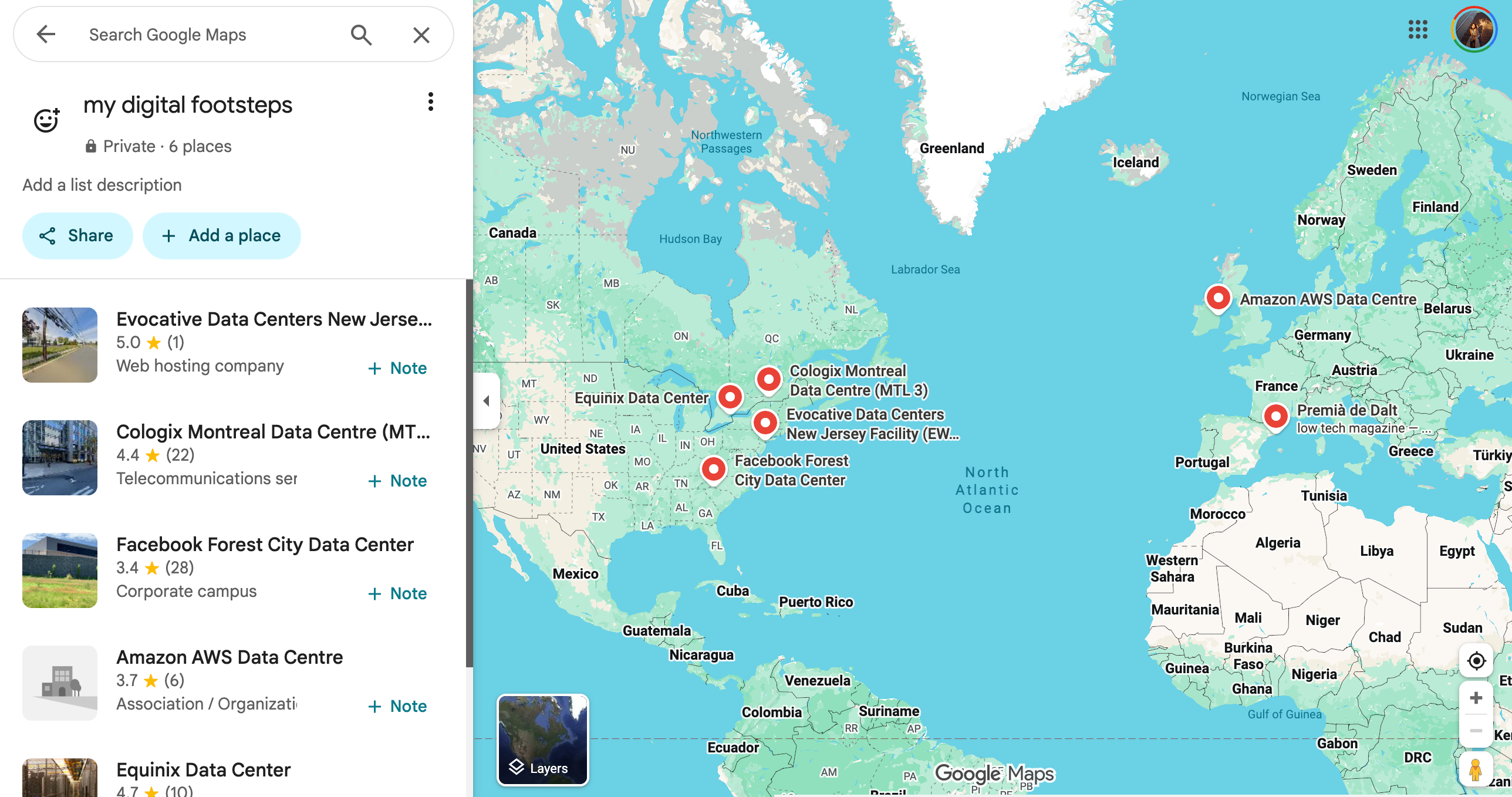
Part of my list included…
Substack (makes sense) — (hosted by Equinix)
NYTimes — Montreal, Canada (hosted by Fastly Inc.)
Whole Earth Index — Toronto, Canada (hosted by Cloudfare)
Are.na — Toronto, Canada (hosted by Cloudfare)
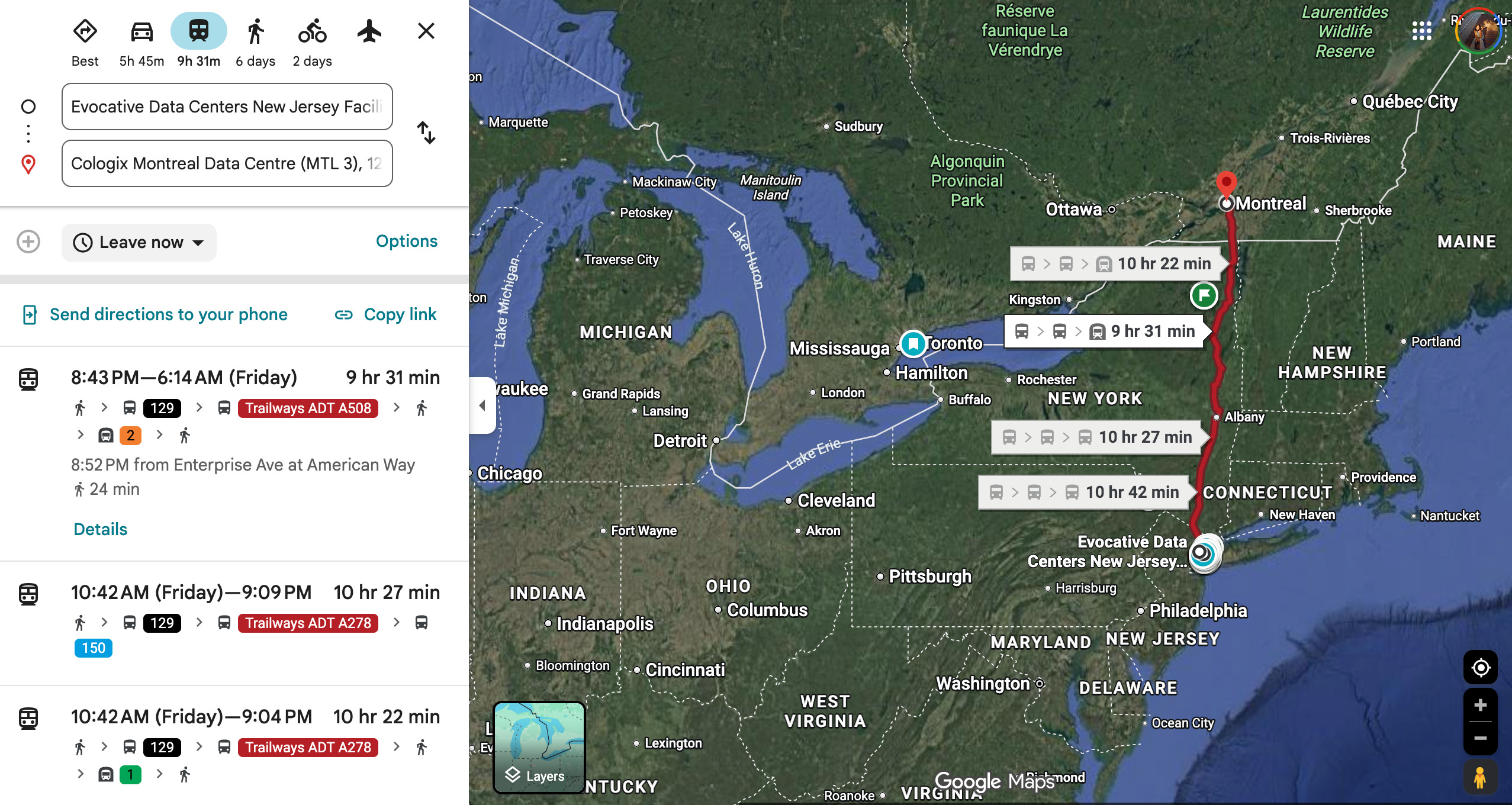
The full journey is roughly 617 miles
Assuming the average person weighs somewhere around 120 pounds and burns 100 calories per mile walked: 617miles × 100 = 61,700 calories. That’s equivalent to…
~3.5 marathons per week for 2 months
~1,500–1,700 miles of cycling
Swimming 1 hour daily for over 3 months
… the premise of doomscrolling is starting to feel physically strenuous, no?
Knowing how much you’re consuming
Why did I do this?
I’ve grown too used to thinking that the internet is this nebulous, abstract space. It seems infinite and eternal… a bottomless pit. I forget that very real resources are used to keep all of our data online.
The same way I try to normalize being less accessible (I shouldn’t have to apologize for texting back a day late), I started to question why the internet must always be ‘on’. We talk about being ‘chronically’ and ‘terminally’ online — wouldn’t this issue correct itself if there were set hours for internet access?

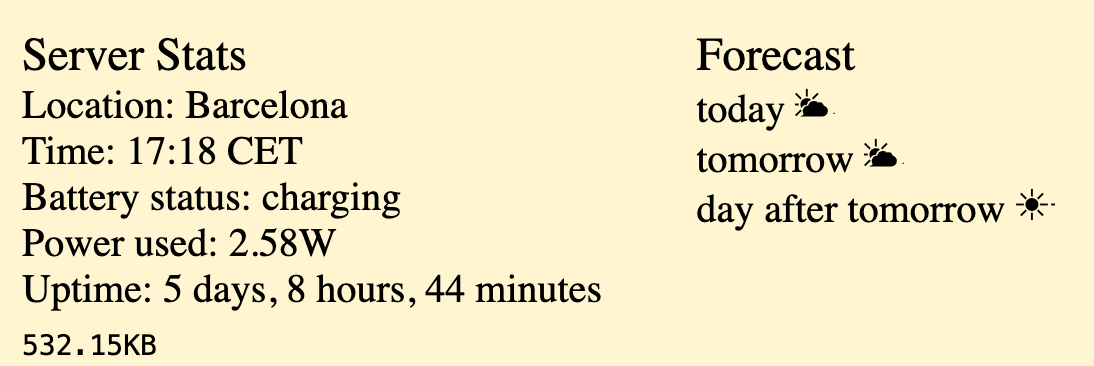
Low Tech Magazine publishes details about their solar-powered server to give us an idea of when their site may be inaccessible. The site also displays how much battery visitor traffic consumes and constantly experiments with their solar power equipment.
I like that I’m made aware of how fragile access can be. I feel the weight of my physical visit to this digital site. The seamlessness of digital experiences conceal its negative externalities: how much energy is used to keep a tab open? How many lightbulbs am burning out by refreshing this Ticketmaster page?
We retreat to the online world on snow days, thinking that the internet is sheltered from extreme weather conditions (its not).
The thing with data centers
Of course, the carbon footprint of any AI-powered activity trumps a visit to a static website. To accommodate the exponential demand for computing power and data storage, Big Tech companies are building data centers wherever they can.
Meta’s looking to spend $10+ billion on a data center in Louisiana. OpenAI’s Stargate initiative is planning to spend over $400 billion dollars. Amazon recently announced a $15 billion Indiana data center expansion project.
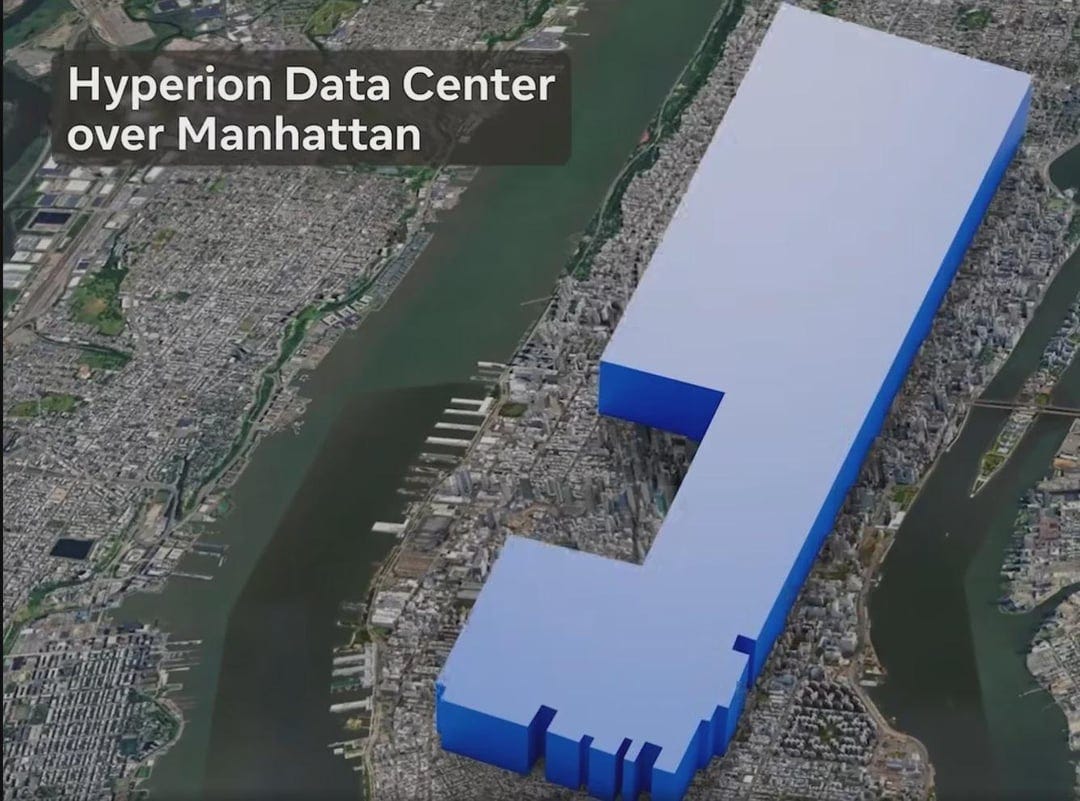
It goes without saying that data centers pose its own set of issues — communities are eager for the job opportunities it provides (temporarily) but wary of its communal impacts (e.g., air pollution, water shortages). The New York Times reported that electricians helping build data center sites can make up to $200,000/yr. They also detailed how data centers have dried up wells and made communities inhospitable.

What does your digital footprint look like?
I was inspired by my friend Spencer Chang1 who documented how he moved his cursor over the course of a day. If all our digital footprints were less ephemeral and carried more weight, could we be more regularly reflective of our habits of consumption?

If we had to physically retrieve the content we doom scroll through today, would we still be consuming so much? This is just a gentle reminder that our digital lives are not without its physical consequences.
I, for one, am apparently on a multi-day trek to Canada.
Hello! If you’ve made it this far — thank you for joining me on my neo-luddite pilgrimage. If you’d like to support some of my more rogue ventures in cyber celibacy (typewriters, building a printing press… more to come), upgrade to paid! You’ll find treats sprinkled in your inbox <3
He’s running an experiment. Here’s how to participate.
There is an amazing body of work you would find interesting having mentioned the Louisiana Meta center: https://risestjames.org They have a very comprehensive newsletter about big industry in cancer alley (petrochemical, oil, now AI).
Having seen some of the commercials Meta is putting on here in Louisiana, the idea that they're bringing jobs and locals are happy about that is such propaganda. Like...name one person they asked! Also thought the whole point was that it didn't need humans to run, so which is it? They are so hypocritical right to our faces. Restoring our coastline is a job, running an actual library you can walk to is a job.
Been doom scroll free for 2 months : )
With love, from New Orleans!