


Turns out, buying a movie on Apple TV doesn’t actually mean you own the movie. You’re only purchasing the license to view it — Apple reserves the right to remove the film whenever, for whatever reason.
Today, we don’t own things so much as we subscribe to something indefinitely. Everything is expensive and made for obsolescence, so we settle for month-by-month access. This (or what I hope to be) the final form of capitalism, makes us forget that owning your media doesn’t just mean being able to infinitely rewatch something. It means bonus features,1 director’s cuts, and watching something on your own terms.


To remind myself of what life could be like free of a recurring bill, I cancelled all my streaming subscriptions. Along the way, I saved a couple bucks, made friends with Aaron (owner of my local DVD store Nightowl Video), and went on a quest to collect original copies of Wong Kar Wai’s filmography before he recolored them for the Criterion Collection’s 4K restoration project.2
What I gave up: video streaming
How did I cope: VHS tapes, DVDs, and copious visits to sports bars.
Did it suck: not at all
We don’t need unlimited access
In line with the initial appeal of Spotify, video streaming once promised unlimited access to most films and TV shows for a flat-fee. It made sense then, when all you needed was one subscription instead of seven that add up to over $100/month (of course, with a bit of finessing, you can get on someone’s family plan… perhaps even access their account).3 I did the math…
Netflix ($18.99) + HBO ($22) + Paramount ($7.99) + Disney ($15.99) + Peacock ($10.99) + Apple TV ($12.99) + Hulu ($11.99) = $100-ish/month.
The argument against physical media boils down to cost: a $25/bluray DVD (multiplied by the 4000+ movies a single streaming service provides) will always be more than the cost of a subscription. But should that really be the comparison?
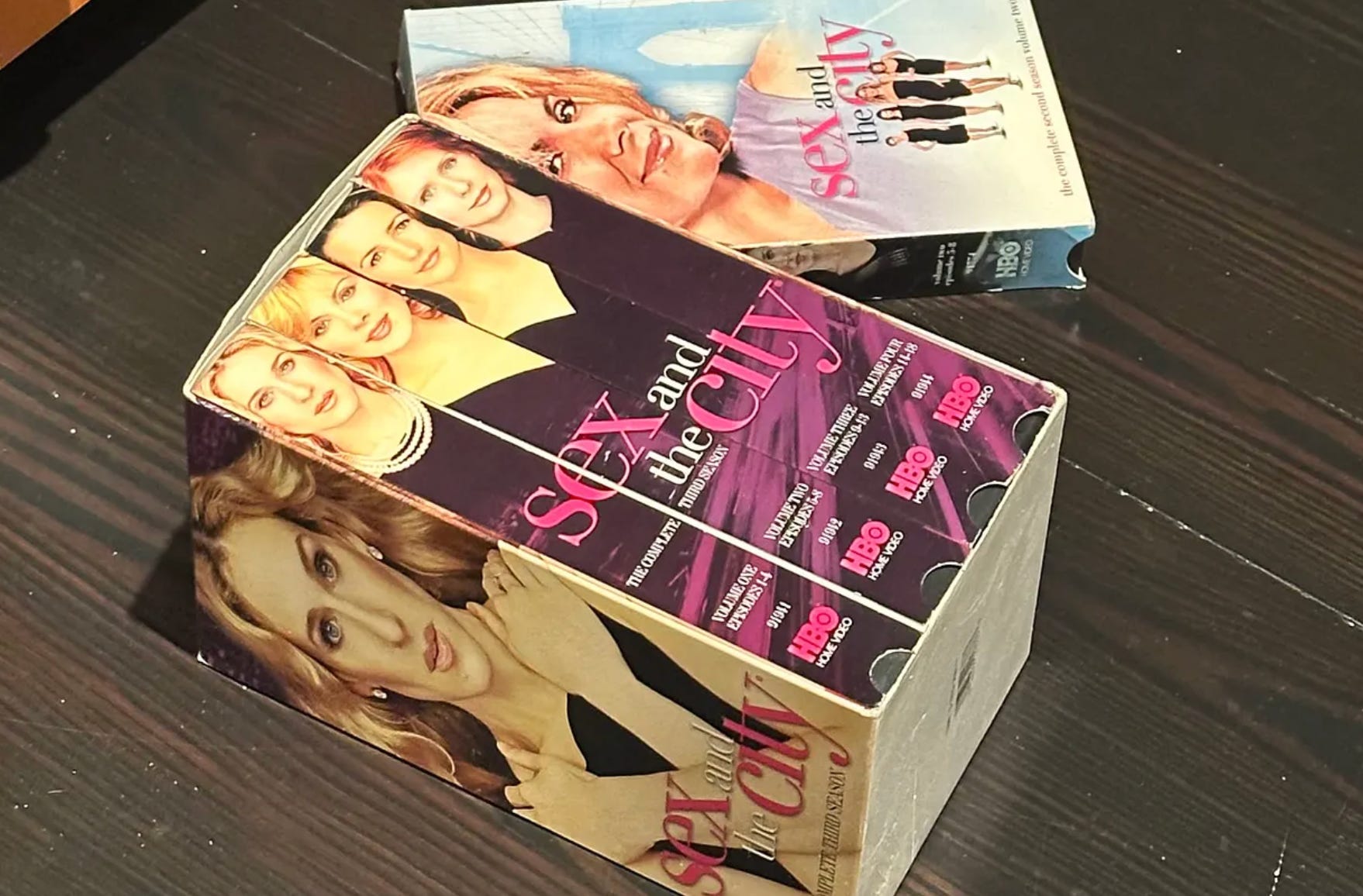
Physical media is cheaper when we care about what we consume
Anyone who knows me knows that TV is my kryptonite. I have the battle scars to prove it —I got scoliosis binging the entirety of The Office in one sitting the summer before college. I like sh*t TV as much as I do *Cinema*, so really I would be the last person advocating for less access to entertainment…
But cancelling my subscriptions triggered a rude awakening.
There used to be soft limits to how much we consumed. Pay-per-rentals imposed a per-unit cost of televised entertainment and the most primitive version of Netflix, sometime around late 90s/early 2000s, only allowed patrons to request up to 4 DVDs at a time.4 Binging a show wasn’t really in the cards (for better or for worse). We didn’t spend hours reading reviews and IMBD summaries just to argue over what to watch. We certainly didn’t scroll during a movie or put on a show as background noise.5


It made me think — do we more care about what we’re watching or just the fact that we’re watching something?
Because hunting for entertainment was so taxing, we used to pay attention to what we watched. The functional value of entertainment wasn’t just sensory stimulation, it was intellectual and emotional fulfillment. I would go so far as to insist that paying close attention to a few films does more for us than half-watching an entire catalog.
Slop (AI or not) is like fast food. It tickles the edges of an itch, but can never be as satisfactory as a proper scratch. The same goes for entertainment: watching a dozen Netflix franchise slop-films6 may stimulate you just enough, but it’ll never be as nourishing as a proper piece of cinema.
By this metric, to bring cost back into this formulation, buying (and owning) 4 real films,7 might actually be cheaper than spending upwards of $100/mo on formulaic films worthy only of being background noise. It goes without saying that abundant access has corrupted our habits of consumption, but we often neglect how our perception of value in entertainment has also eroded.
Entertainment is social!
It is a bit of a cop out for me to quit streaming the same summer of the World Cup, NBA finals, and triumphant return of Love Island. The unofficial $9ish entry fee (price of a beer) to the handful of sports bars near me does introduce a new variable to my argument on cost, but reveals a very valuable difference between on-demand and live entertainment: camaraderie.
Everyone is watching the same thing, at the same time. Sharing the same emotions, reacting in real time. We may not know each other, but we all made plans to be here. Movies have always brought people together, so why does streaming feel so isolating?

Watching the Knicks win the NBA finals then flooding the streets with the rest of the city reminded me of the fundamentally social nature of entertainment. Strangers were crying in each others’ arms, congratulating one another, making new friends.
Outside the world of sports, there’s Lyas’s fabulous fashion week watch parties, The Summer I turned Pretty bar hops… let us not discount the community-building power that this season of Love Island wields. Entertainment is something we do together!
Want to be part of this experiment?
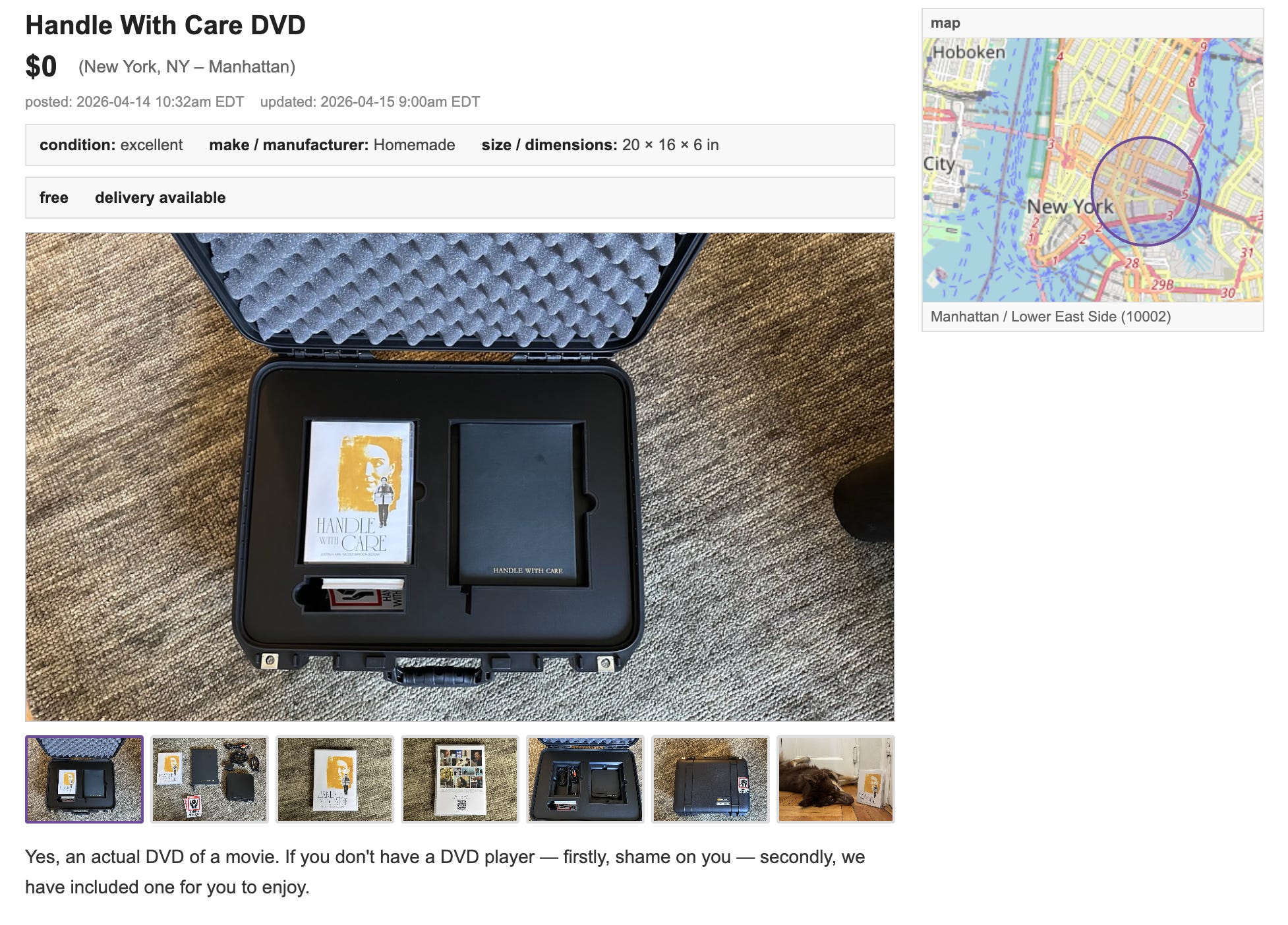
I actually met a stranger, Matt, (who happened to be a subscriber) off a craigslist listing for DVDs. Over coffee, we bonded over our complicated relationship with Letterboxd and the fact that we were wearing the same pair of Acne Studios loafers. MJT, who’s a filmmaker, recently finished his feature starring Umbrella Academy’s justin Minn and wanted to share it the same way he bonds with his elderly neighbor — through DVDs. So this summer, instead of continuing this streaming-free journey alone, we decided to run an experiment together. The premise is simple:
There’s only one copy of matt’s film
The film is stored in a briefcase, along with a dvd player and a notebook
Sign up (someone also participating will hand you the briefcase)
Watch the movie, write your review (it’s like a guest book!), then pass it along
The hope is that, by handing this physical film around New York City, we create more opportunity for connection. Maybe, the same way Matt and I became fast friends, more folks can break outside their bubble… and make entertainment social again!
They don’t make ‘em like this anymore
Remember bonus features?
I’m not entirely sure why but —despite never having seen the actual movies— I spent much of my teens watching Lord of the Rings Behind The Scenes documentaries.
Maybe it’s the awe of seeing thousands of people bring Peter Jackson’s whimsical vision to life without AI: hand-painted sets, artificially grown moss, days spent lighting a miniature set to make it look giant. Everything was a labor of love with attention to details that don’t always translate onto the screen, a striking contrast to the half-assed year-round hallmark movies we seem to be getting today.
It’s painfully evident that the industry is capitalizing on our ever-dulling tastes: A24 just signed a new deal with Google, Netflix quietly launched an internal AI-studio INKubator, and Lionsgate’s been shouting its partnership with Runway off rooftops.
Maybe it’s up to us to demand entertainment that isn’t… unremarkable. Look what we did with Backrooms and Obsession!
Hello! If you’ve made it this far — thank you for joining me on my neo-luddite pilgrimage. If you’d like to support some of my more rogue ventures in cyber celibacy (typewriters, building a printing press… more to come), upgrade to paid! You’ll find treats sprinkled in your inbox <3
Pixar Bloopers. Never forget.
Fred again also regularly replaces his files on streaming services.
Thanks Bala <3
Netflix only discontinued their mail-in DVD service in 2023.
If you paid $25/episode of Seinfeld you watched while cooking, it might actually be cheaper to go out for dinner.
They seem to be pumping those out these days.
An AMC membership pays for itself after two!
If buying isn't owning then piracy isn't stealing. When companies choose to make something available only as a digital license, then remove it whenever they decide, then all you've bought is limited access.
It’s really concerning to think this could begin to affect books too (if it hasn’t already), not just films and games. There’s something unsettling about a future where we pay for things but never truly own them. We’re just given permission to access them until someone decides otherwise.
I recently cancelled my Netflix and now tragically have to get by only using my friend’s disney +. But I was thinking about how you feel like you paying for all of these movies and shows but realistically how many are you actually watching per month? For me, not that many. Like you said, you’re more paying for the ability to scroll endlessly and then watch something you weren’t even interested in. Maybe I will start using DVDs too 🤔