


The origins of Big Tech are anti-establishment.
Terms like “disrupt,” “democratize,” and “revolutionize” defined the early conversations of the Valley. The Whole Earth Catalog (a canonical text of the 60s counter culture) was the bible of early tech founders, just as cryptocurrency —as a form of protest against the surveillance state— rose to popularity was a phenomenon born out of the Cypherpunk movement. Tech was always about individual agency and mobility. For one, by simply popularizing the personal computer in the 90s, Apple took the computing power of IBM mainframes and gave it to the masses.
AI companies are selling us on a similar promise, but I’ve long dismissed this premise until an email I got last week made me think twice.

Could vibe code end proprietary tech?
Just a week-ish back, the so-very demure headline: “THIS IS WHY ADOBE IS F*CKED” sat at the top of my inbox, where a fantastic mix of sarcastically techno-optimistic prose walked me through how the software engineer Brandon Thomas rebuilt Adobe’s Creative Suite and Microsoft Office, but “better.”

He made his clones open source AND compatible across different operating systems, challenging the ability for tech giants to charge exorbitant prices and enforce questionable policies for access to their proprietary technology (I wrote about this for Wired years ago). Let’s not forget Adobe almost acquired Figma. Thomas himself built the dupes because Adobe charged him their $150 cancellation fee one too many times.
In a way, Thomas stuck it to the big guys by reverse engineering their tech. He’s giving agency back to the individual user. Right? You can now download an Adobe-dupe and customize it however you like. You’re free from having your data mined right left and center! You’re no longer forced to let embedded LLMs train on your creations. Access isn’t gate-kept behind a subscription model because all the code you need to run these programs can be downloaded on Github —get this— for free.1
Attractive as this project is as an example of AI “democratizing access” and challenging “institutional power,” there’s the cute little caveat that all this was done using Claude. To be clear, Thomas’ clones did NOT come from a simple vibe-code prompt: Build Adobe but better. Don’t make any mistakes. It’s not necessarily AI slop. Thomas claims that it’s a mix of reverse engineering public file-format specifications and setting up AI agents, leveraging his 15 years of engineering experience. The product is also not hosted by Claude, so it doesn’t necessarily need Claude to be maintained or used. There’s already a growing community around Thomas’ project: Discord channels forming with hobbyists helping each other troubleshoot their clones, vibrant Hacker News threads discussing the reliability of Thomas’ software.

At its core, what I found most intriguing about these dupes is how the discussions around the adoption of it boils down to a sort-of blurrier, less grotesque Trolley Problem: to protect multiple industries from being exploited by proprietary technology, is it permissible for Thomas to use AI and (in effect) sacrifice natural resources and enable labor displacement —among AI’s other serious negative externalities? It seems silly to blatantly dismiss the prospect of displacing tech giants (each responsible for their own camp of exploitative, monopolistic policies) simply because the person who built the software used AI. Again, users of Thomas’ work DO NOT need AI to run these pieces of software.
Thomas pits the threats of AI directly against the exploitative practices of proprietary technology, despite relying heavily on proprietary technology (Anthropic’s model) himself to build this project. So, where should we draw our ideological line? Should our aversion to AI be deontological or utilitarian? The former is just a little harder to achieve, considering how almost everything in our lives uses AI — sending an email uses AI, drinking water (at least in New York State) uses AI. The list goes on.
Tech activist icon Cory Doctorow had an interesting take.
Policy is the real bottleneck
I was recently at Backmarket’s Slow Tech Summit (The Slow Tech Times) in Paris, where policymakers and activists came together to discuss international right-to-repair movements. I brought this moral predicament up to a couple folks, but I was especially taken by the position that their keynote speaker Cory Doctorow held.
Known for coining (or popularizing) the term “enshittification,” Cory’s magnum opus is the concept of Adversarial Interoperability — the premise of creating a new product or service that plugs into existing proprietary systems without the permission of the companies that make them.

And while Thomas’ work seemed (to me, at least) a prime example of Adversarial Interoperability, considering how his open-source technology would theoretically replace existing proprietary systems, Cory was clear that approaches like Thomas’ are 1) not sustainable or scalable, and 2) doesn’t address the crux of the issue. 2
“The main hurdle to fixing defects in the technology you use is policy, not technology. The problem with vibe coding is that it would let you or me figure out how to jailbreak your phone. No one is going to make an app store for you if you jailbreak your phone.”
And he’s right! Cory describes the many institutional hurdles engineers like Thomas face in their attempts to introduce sustainable, alternative technology. Distributing the software would be challenging when everyone uses an operating system owned and maintained by companies that aren’t interested in promoting open-source tech. Thomas’ tech might work now, but it certainly will not in the future.


Cory’s position also made me think: tech giants have made their tech easy to use to protect us from the so-called “chore” of learning how our tech actually works (which, obviously, makes us more dependent on them). Even if Thomas’ tech were flawless, these institutional hurdles would prevent him from releasing a version that’s perfectly compatible with the three main systems people use today. I suspect that tech like Thomas’ would struggle to be frictionless to adopt (insofar as the workarounds required to run the software require a degree of technical expertise).
This puts the onus on us to learn about the tech we use in order to dismantle the power that tech giants have over us.
I was tickled when Backmarket’s head of sustainability, Marie Castelli, told me that “in Europe, we fight for the right to repair for sustainability reasons. In America, they want the freedom to repair and the right to own their tech.”
Cory thinks that Trump might accidentally save us all
At the end of the conference, I asked Cory how much agency we have as individuals in this fight against Big Tech. He told me we have very little… if any at all.
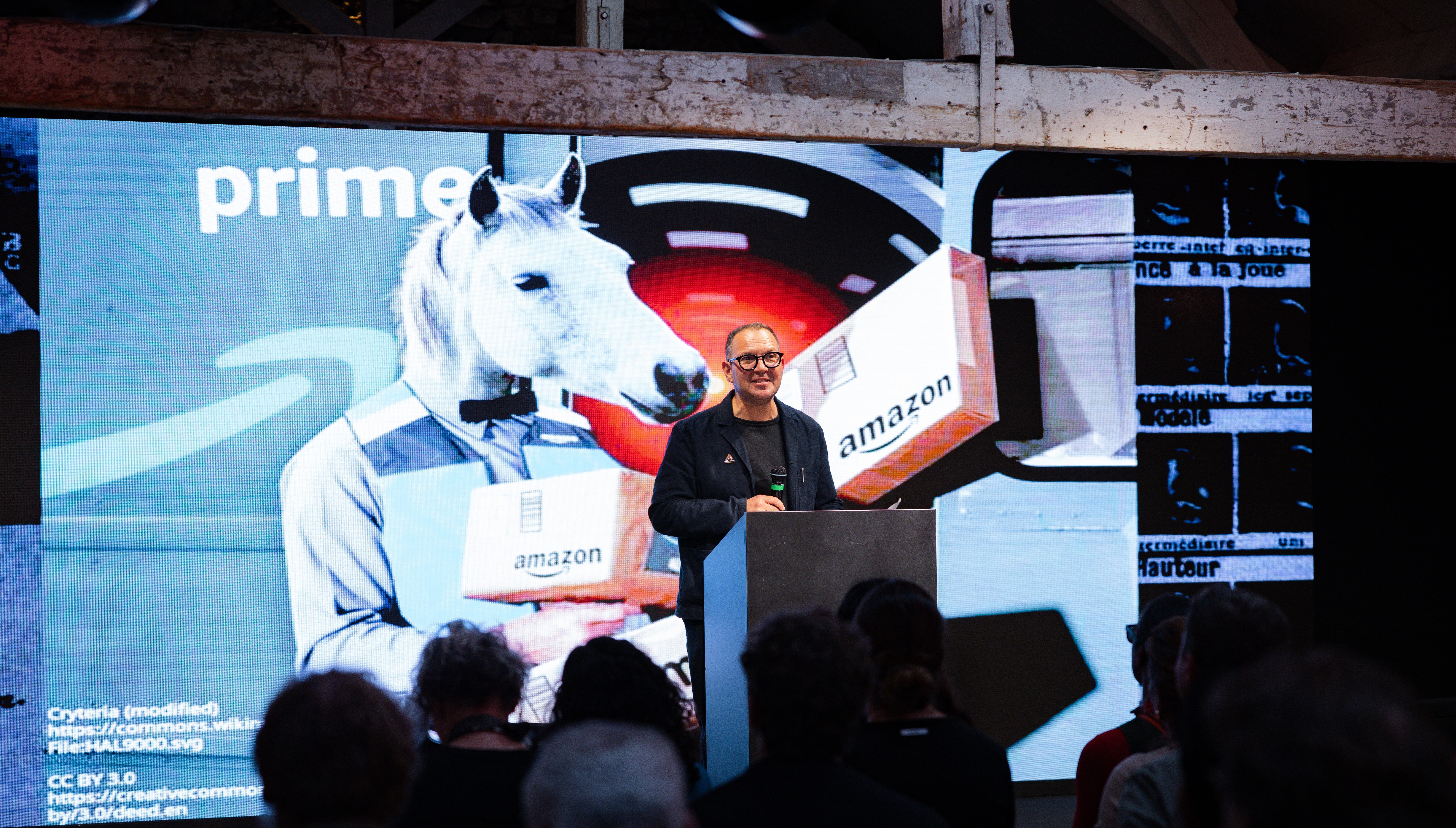
Advocating for better government regulation, to his point above, is the answer. But we’re not shit out of luck. Cory actually made this fabulous point that Trump’s impulsive policies have actually unknowingly paved the way for better tech regulation.
“When Trump started weaponizing US tech platforms to take away the working files, email accounts and cloud calendars of judges who pissed him off (by sentencing Bolsonaro to prison and swearing out a genocide warrant for Netanyahu), he put the whole world on notice that he could shut down their governments, judiciaries or companies at the click of a mouse. And of course, he’s whacked the whole world with tariffs that violate the trade agreements that imposed those anti-circumvention obligations that protect America’s defective tech exports. Now there’s no longer any reason to keep those laws on the books. Happy Liberation Day, everyone!”
Cory lays out how countries around the world, in hopes of maintaining a healthy relationship with the US, resisted tech regulation. None of that applies today though, a la Trump’s tariffs and international wars. Maybe there is hope for us after all.
… what do you think?
Hello! If you’ve made it this far — thank you for joining me on my neo-luddite pilgrimage. If you’d like to support some of my more rogue ventures in cyber celibacy (typewriters, building a printing press… more to come), upgrade to paid! You’ll find treats sprinkled in your inbox <3
There are specific operating costs associated with Thomas’ tech. But Thomas himself doesn’t charge the user (for now).
I decribed Thomas’ project in the abstract to Cory. I did not specifically describe ArtCraft.