


As someone who writes for a living, a little piece of me dies every time a perfectly innocent word is co-opted by either the internet, Big Tech, or Corporate America.
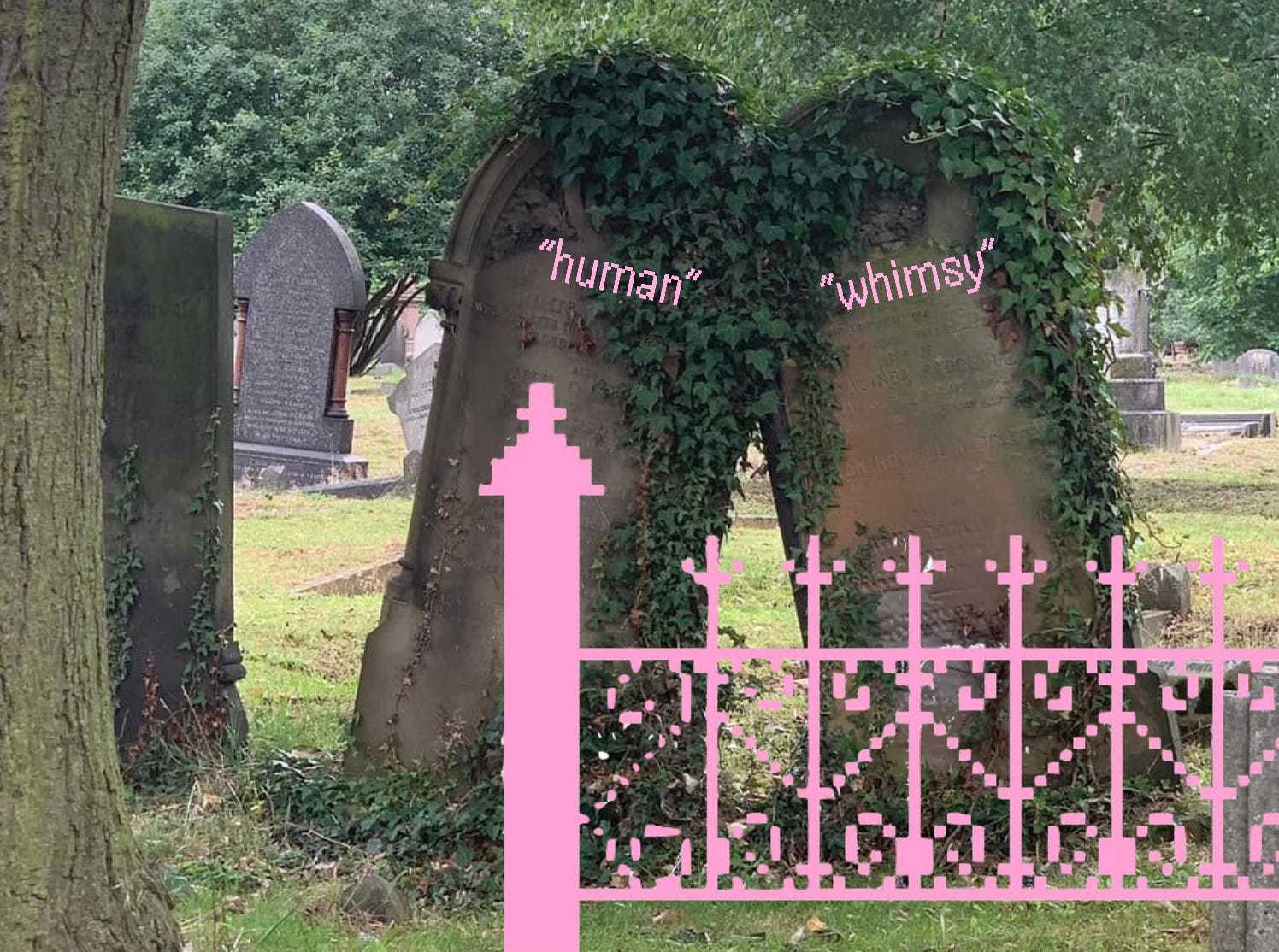
There was a time I could use the term “human” without feeling my skin crawl. “Chic” or “vibe” conjures a secondhand cringe I can’t quite describe. Depending on which side of the algorithm you’re on, “community” and “agency” mean different things.
Today, media cycles are so short and sensationalist that terms are being used to capture entire movements. Even if the movement only lasts a week (RIP protein-maxxing). Regular words are constantly undergoing a rebrand — it’s impossible to understand what people really mean. How did we get here?
Social media vs. Para-social media
This linguistic spiral happened when I read Cornell professor danah boyd’s1 paper on how “social” media should be renamed “parasocial” media. The pivot from active engagement (meeting online then making plans IRL) to passive consumption (doomscrolling), boyd argues, warrants a semantic change.
Before the internet started mining attention, it was just a digital infrastructure that brought people together.2 Apparently, early internet users flirted with terms like “social computing,”3 “Web 2.0”, and “social networks” before we collectively landed on social media.
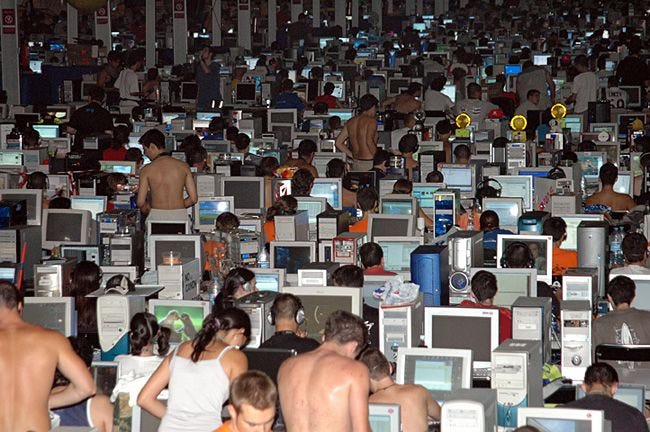
Back then, there wasn’t a monolithic platform/service/thing that centralized online traffic — the internet was a collection of homemade software, indie websites,4 servers hooked up to literal networks. People were just searching for a term that could encompass “any type of computing application in which software serves as an intermediary or a focus for a social relation.” Enter Social Media.
“In 2006, we imagined a social media ecosystem that prioritized strengthening connections through media”, boyd wrote (instead of developing relationships with media). A decade ago, media was in service of the social.
Now, we consume parasocial-media to escape.5
We modeled our digital lives after our physical ones
Words have always had lifecycles of meaning. “Slay” has meant everything from murder to success. “Pussy” has meant everything from cats to cowards. There’s a term for this shift: resemanticization.
Internet linguist and author of Because Internet: Understanding the New Rules of Language, Gretchen Mcculloch, uses the phrase “lol” to explain the phenomenon: first, a phrase is coined for a specific function (L.O.L. as in laugh out loud). Then, as more users use the phrase in different contexts (lol as an expression of non-chalance), its secondary meaning becomes its dominant definition.6
The Apple manual that popularized the term “scroll”
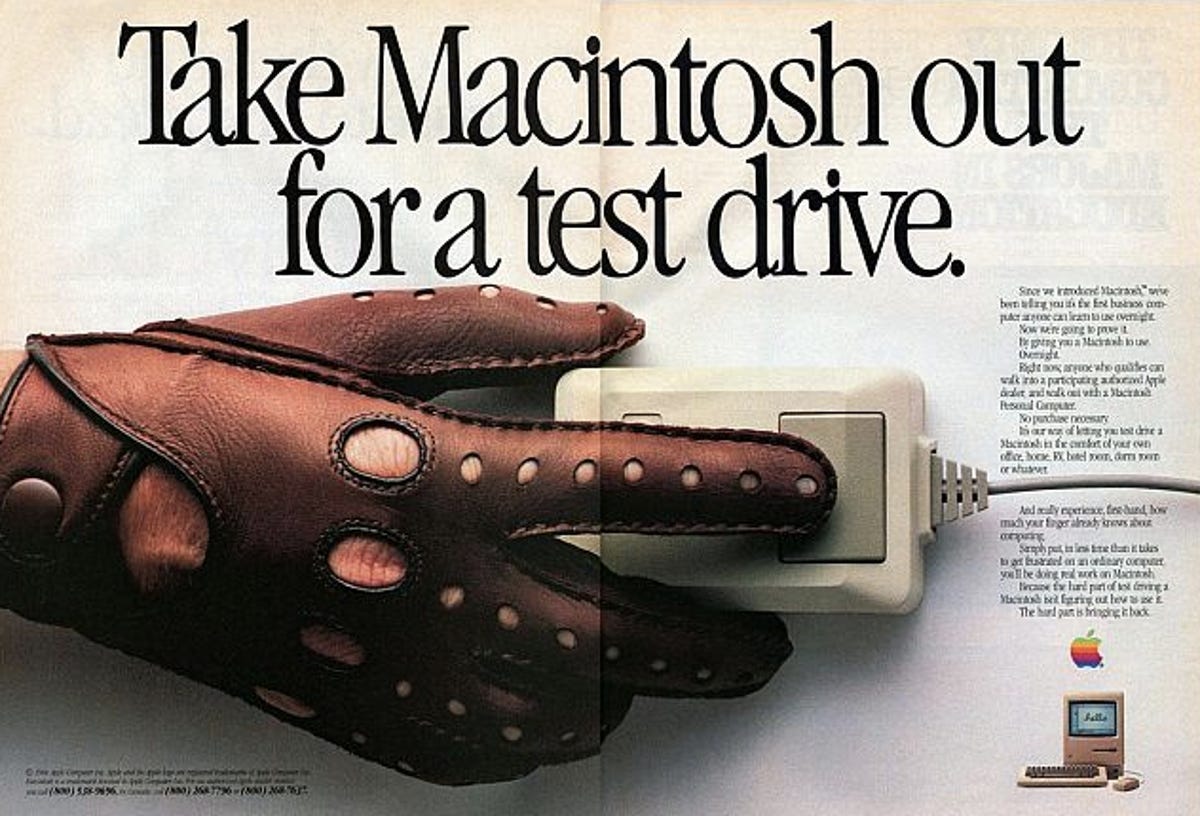
Before Apple,7 “mouse” exclusively meant rodent, “window” mostly meant big square holes in your wall, and a “scroll” was a long piece of papyrus, parchment, or paper.
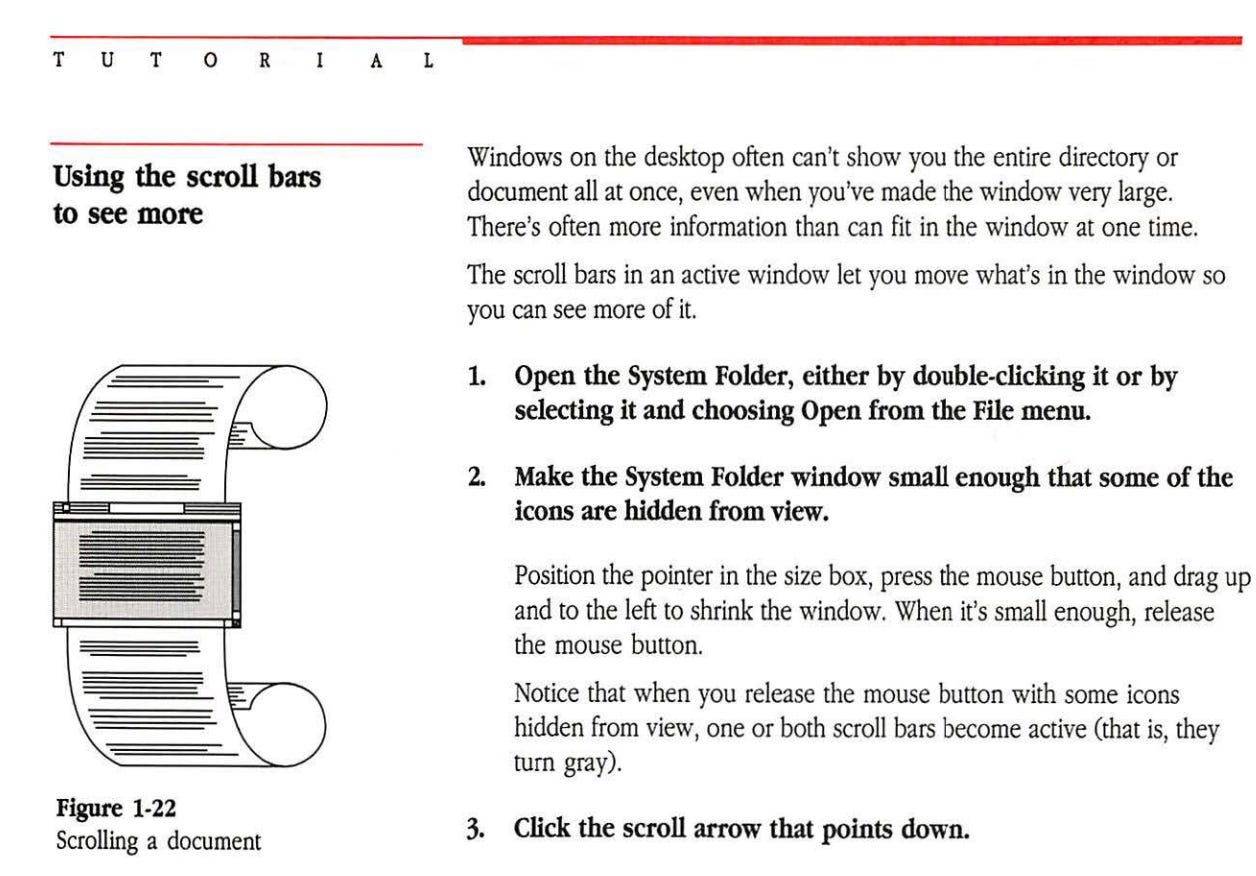
But in 1984, when Apple introduced the Macintosh with Ridley Scott’s (dir. Blade Runner) iconic Super Bowl ad,8 the concept of User Experience was born. Steve Jobs wanted to make computing power intuitive to the average person (he was following the footsteps of his counter-cultural contemporaries), and with the help of technical writer Carol Kaehler, put together a user manual that used concepts of our “real” lives to help users navigate the digital sphere.
Suddenly, words with one fixed meaning was given a digital double, and we had to make sense of the digital sphere using concepts from our physical lives.
R.I.P. “Authenticity”
Over time, our digital lives stopped referencing our physical lives and started informing it. When these paradigms merged (Apple brought people closer to technology + early “social media” made it easier for people to connect), the shift from social to para-social media gave way for performance.
Byung Chul Han’s Disappearance of Rituals9 dissects our emergent fixation on “authenticity.” His chapter The Compulsion of Authenticity opens with:
“The society of authenticity is a performance society… the cult of authenticity is an obvious sign of the decline of the social.”
It’s easy to forget that we used to follow strict rules of etiquette. Respect and politeness came from the exhibition of explicit social cues which, at times, were fantastically obnoxious.10 Authenticity came from the absence of these rules: when you came home from a long day of curtseying and holding your pinky up.
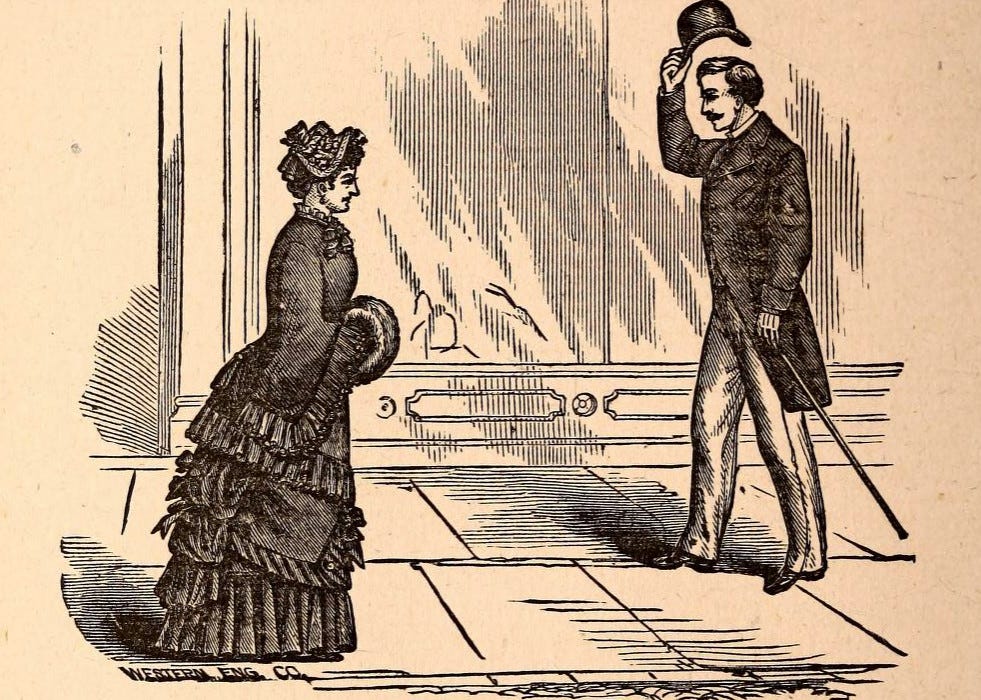
“Today, the world is not a theatre in which roles are played and ritual gestures exchanged, but a market in which one exposes and exhibits oneself,” Han added. There’s such an appeal of showing the most un-manicured versions of ourselves online that being “raw” has become an aesthetic. But how can “authenticity” be authentic when it’s performed?
In Memoriam: Whimsy
The internet redefined “authenticity” the same way algorithms are redefining “whimsy,” the victim to an unceremonious murder of discovery.11
The infinite (personalized) scroll replaced chronological timelines and our laziness limits our worldview to whatever echo-chamber we occupy,12 so exhibiting any defiance to the algorithmic mainstream is rewarded — hence “whimsy-maxxing.”13
Whimsy, defined by the internet loosely as embracing your inner child, is gaining traction. The term has an anti-capitalist aftertaste, perhaps because its internet aesthetic is colorful, non-sensical, and against optimization (influencers like Madison Wild attach whimsy to wearing a shirt wrong, substacks preach reviving childhood traditions, technologists celebrate websites that have no functional purpose).14
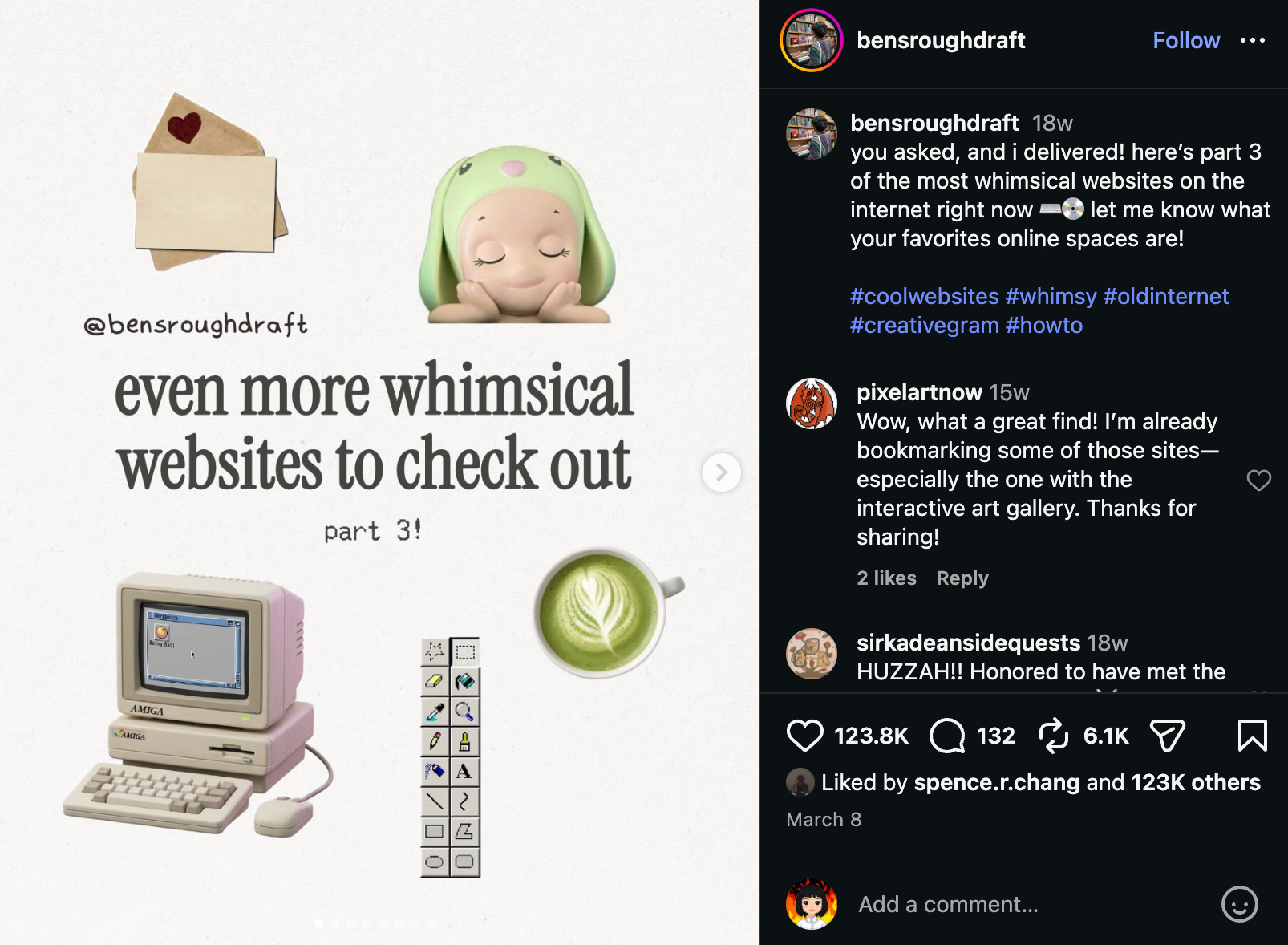
But at it’s core, whimsy is just doing something on a “whim.” There shouldn’t be aesthetic attached to it. My inner-narc has developed a visceral distaste for the nouns that have become adjectives (eg. taste, aesthetic, whimsy).
Everything has an aesthetic. “Aesthetic” doesn’t mean aesthetically pleasing.
Everyone has taste. Having taste doesn’t mean having good taste.
Anything can be subject to a whim.
John Waters’ (gorgeous) I Don’t Think So Honey take perfectly captures this fallacy: “I hate it when airlines say your flight is cancelled because of weather. There’s always weather!”
AI is re-semanticizing our lives
Everyday, a new word falls victim to The Discourse (online and offline).15 We can’t really use “common sense” without thinking of party lines and fake news. But AI seems to be supercharging a new wave of mass-resemanticization. This time, the semantic pivot centers around the dichotomy of human vs. AI.
For one, the phrase “human” (having suffered only half a decade of abuse) has lost most of its meaning by being used to simply mean “NOT AI”. Words like “evangelize” and “demystify” tap into the very spiritual way that Big Tech companies are positioning AI.16 We’re constantly writing against AI (why must I be deprived of an em dash!!!!).
Our verbs are changing too — we don’t “ask” AI anymore now, we “prompt.” We don’t “design” things, we “engineer” things. We don’t “take pictures” now, we “create content.”
The lifecycle of a word is shrinking as much as its meaning is fragmenting. How we understand each other now depend on the corners of the internet we occupy. We’re constantly finding new words to represent old words that have been co-opted.
Will you hate me if I said I’m over “enshittification” and “slop”? What happened to good old fashioned “degradation” and “shit”? Not everything has to be a brand.

*Honorable mentions*
The occasional corporate idiom does tickle me. Someone asked me if I had the “cycle” to do something;17 I overheard someone replace “agree” with “problem solve” (they said ‘wanna problemsolve dinner?’). But my all-time favourite has to be…
Mutually Exclusive, Collectively Exhaustive (MECE) 18
Which apparently means “breaking a problem into parts with no overlap and no gaps.” But to me meant: different things that collectively exhaust me.
Hello! If you’ve made it this far — thank you for joining me on my neo-luddite pilgrimage. If you’d like to support some of my more rogue ventures in cyber celibacy (typewriters, building a printing press… more to come), upgrade to paid! You’ll find treats sprinkled in your inbox <3
Remember Meta (facebook)’s grand mission of “bringing the world closer together”?
Describing a website as “indie” only really makes sense now. The internet didn’t use to be this centralized.
I still fondly recall the first Tim Wu paper I ever read about the ethics of search engine rankings. Seems a little quaint to our current moment, no?
“kms” has entered my vocabulary as the replacement of “fml” (but “f*ck my chungus life” does have a sweet, tingly ring to it)
Steve Jobs didn’t invent the technology for the mouse. Douglas Engelbart did. Jobs only popularized the Apple computer pointer with the introduction of the Macintosh. Check out this gorgeous website about Engelbart’s contributions to human computer interaction.
I’ll never forget the line: “On January 24th, Apple Computer will introduce Macintosh. And you’ll see why 1984 won’t be like 1984.” Banger. 200 extras were paid $125 a day to shave their heads and march in lock-step. BACK IN THE 80s!
I’ll never stop quoting Han!!!
According to the British manual, The Habits of Good Society: A Handbook of Etiquette for Ladies and Gentlemen, a proper lady should only have one glass of champagne. Lol no!!!
There’s 101 essays on how algorithms flattned culture. Take your pick.
It’s also kind of our job to go out and discover things for ourselves.
Can I just say, I hate the “-maxxing” suffix SO MUCH
My buddy Adam Aleksic does a lovely job explaining why.
Did you know that Elon Musk’s network is nearly double that of the entire AI industry
Literally what the fuck does this mean
I figured this joke would do numbers on LinkedIn
This was so interesting, and I had noticed this overuse of 'whimsy' recently too and couldn't put my finger on why it irked me so much. You've perfectly encapsulated it and more!
One of my mums favourite words to use to describe basically cute things was 'whimsical' (an adjective, used correctly), so I liked that word too, but now it just makes me cringe, which I hate! Internet give me back my favourite word!
Unfortunately I feel like the whimsy movement is anything but anticapitalist :( I’m constantly seeing lists of “whimsy” outfits/accessories/trinkets/home decor items you NEED RIGHT NOW!! It bugs me that they use the word wrong in the first place, but it makes it even worse to suggest that whimsy is something that can be bought on Amazon