


Logging back onto the the dating apps after a 3 year hiatus was traumatic.1
No one told me we use AI to *optimize* our profiles now. I was impressed by how unhinged audio prompts were and shocked by the abundance of AI-generated slop. It was humbling—to say the least—and entertaining at most. I couldn’t help but wonder: was online dating ever… not a hellscape? Is ‘analog’ dating really the solution?
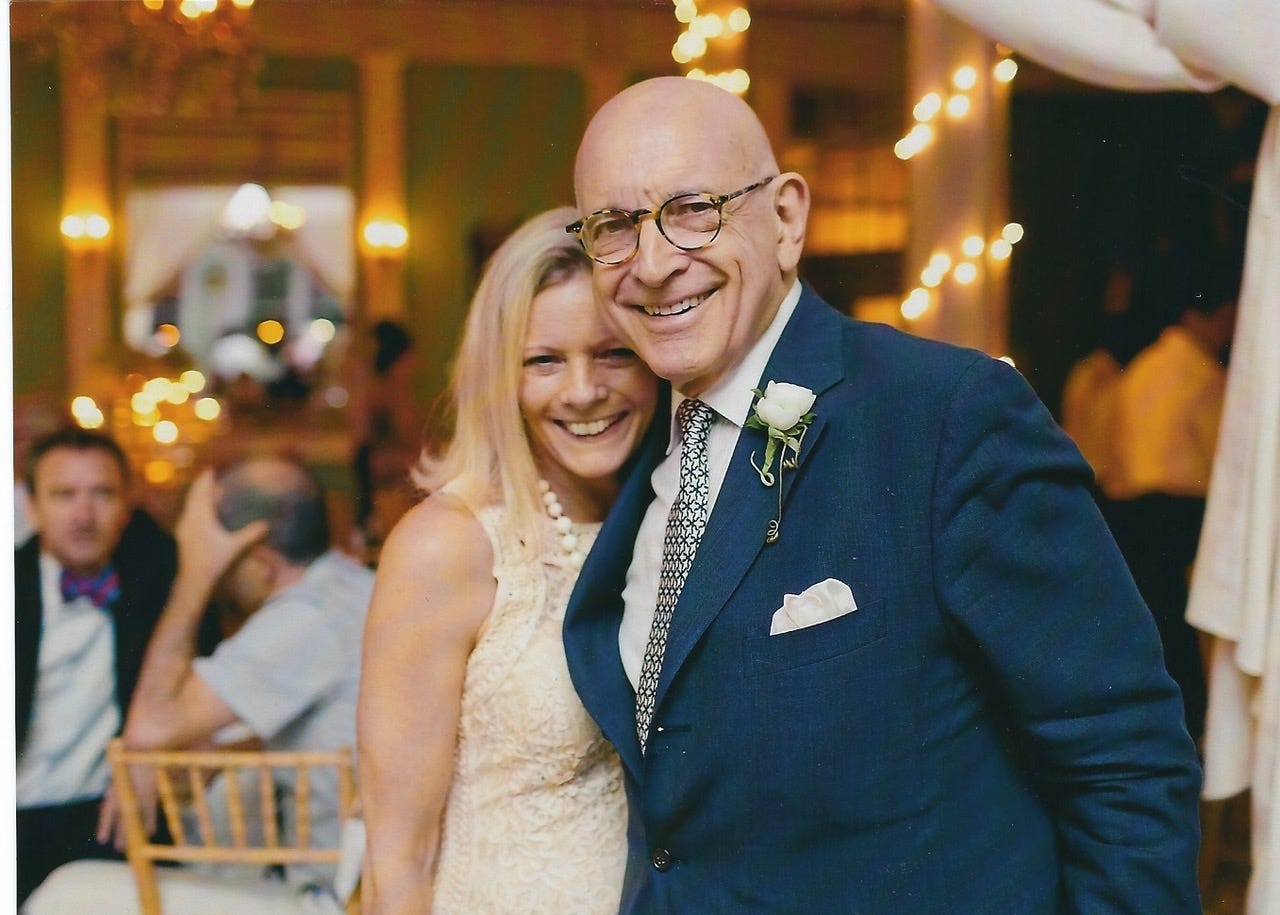
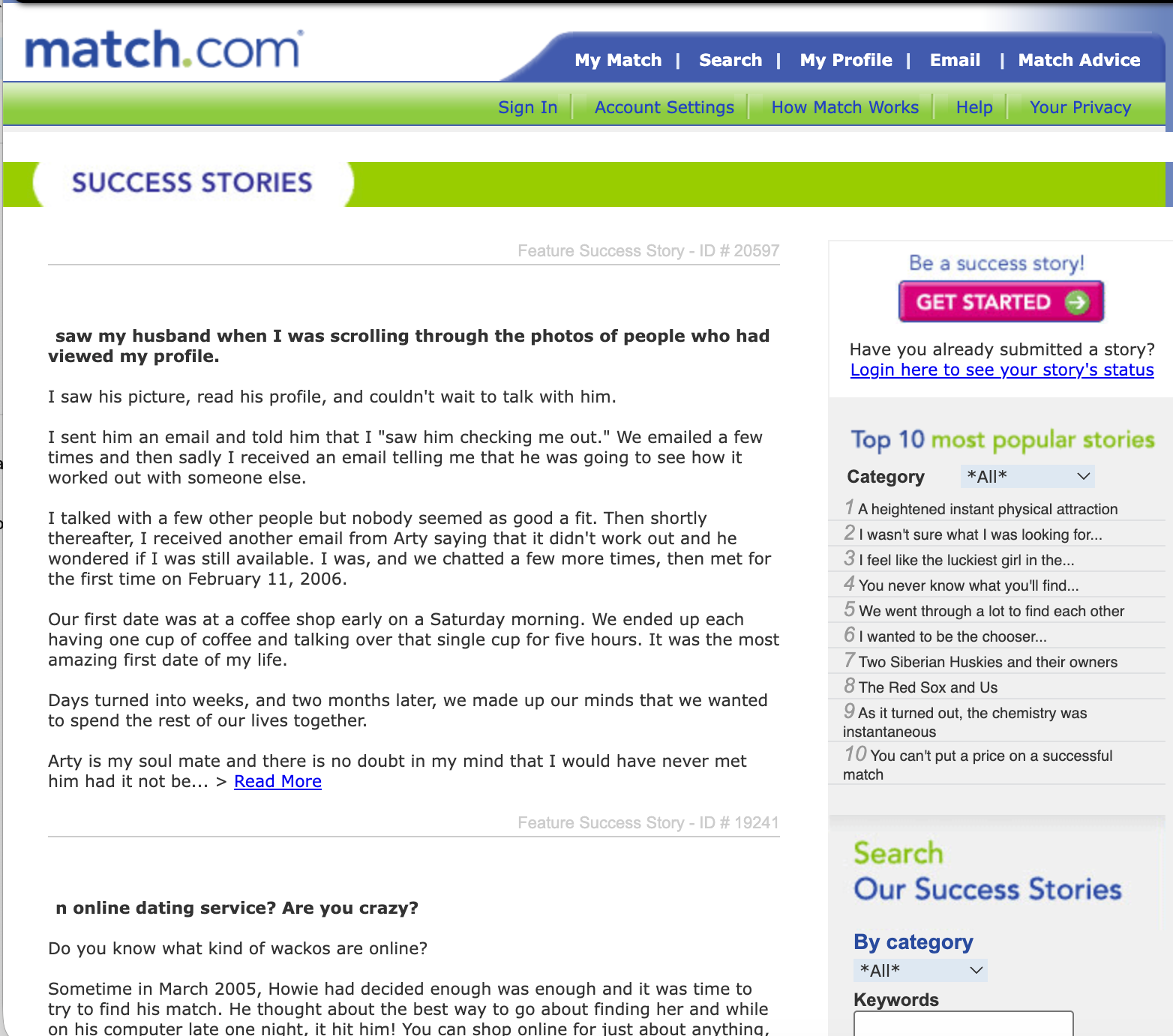
To Hal and Jeanne-Marie, a couple who met on OkCupid in 2009 and got married in 2015, the answer is a resounding yes.


For over a decade, Hal and Jeanne-Marie lived a block away from one another and never met. It was only on OkCupid, when Jeanne-Marie came across Hal’s charming profile, that their courtship began. At the time, Hal was 69 and Jeanne-Marie was 58. They were both in advertising, navigating a life after marriage, and really into jazz. The story of how they met is a tender one, but journey that brought them there wasn’t always so.
For one, Jeanne-Marie—who loves to dance—signed up for partner dance classes thinking she might meet someone during a tango. She says she must have danced with 1,000 men over her few years of being single, and met no one with whom she had much in common. This finally led her online where she met 30 or 40 more guys with nary a spark. One guy even faxed her half the dinner bill after she turned down a second date!
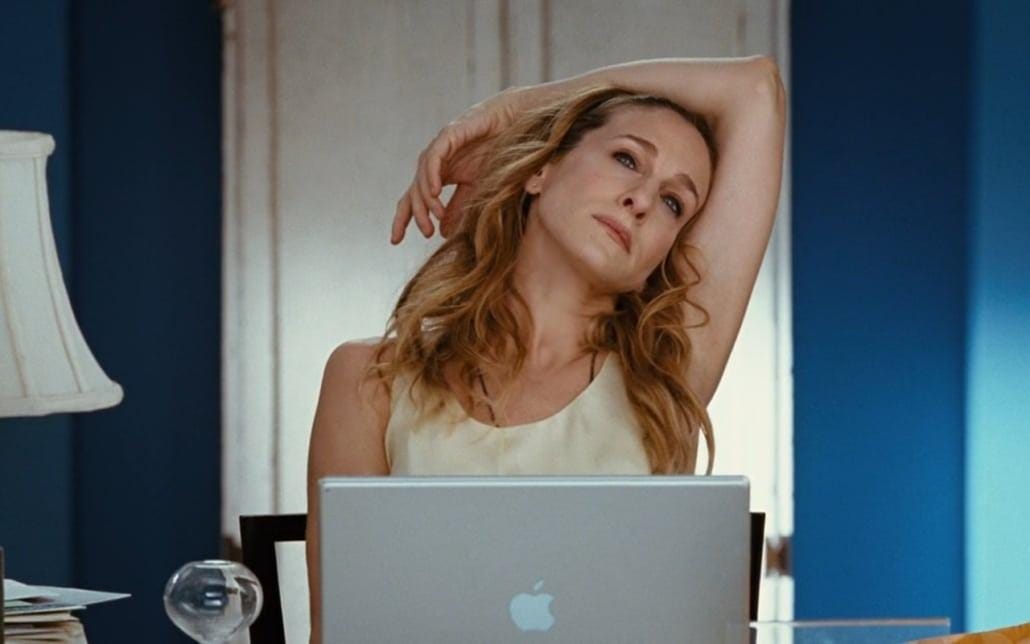
Still, online dating back then was—in comparison—easier. There was more room to be earnest. What happened? Did the internet ruin dating?
It’s easy to romanticize a past I never lived, so I asked Hal and Jeanne-Marie to spend an afternoon with me doom-swiping through a few dating apps.
To date is to perform
“Is this a joke? ‘I’m figuring out my dating goals?’” — Jeanne-Marie.
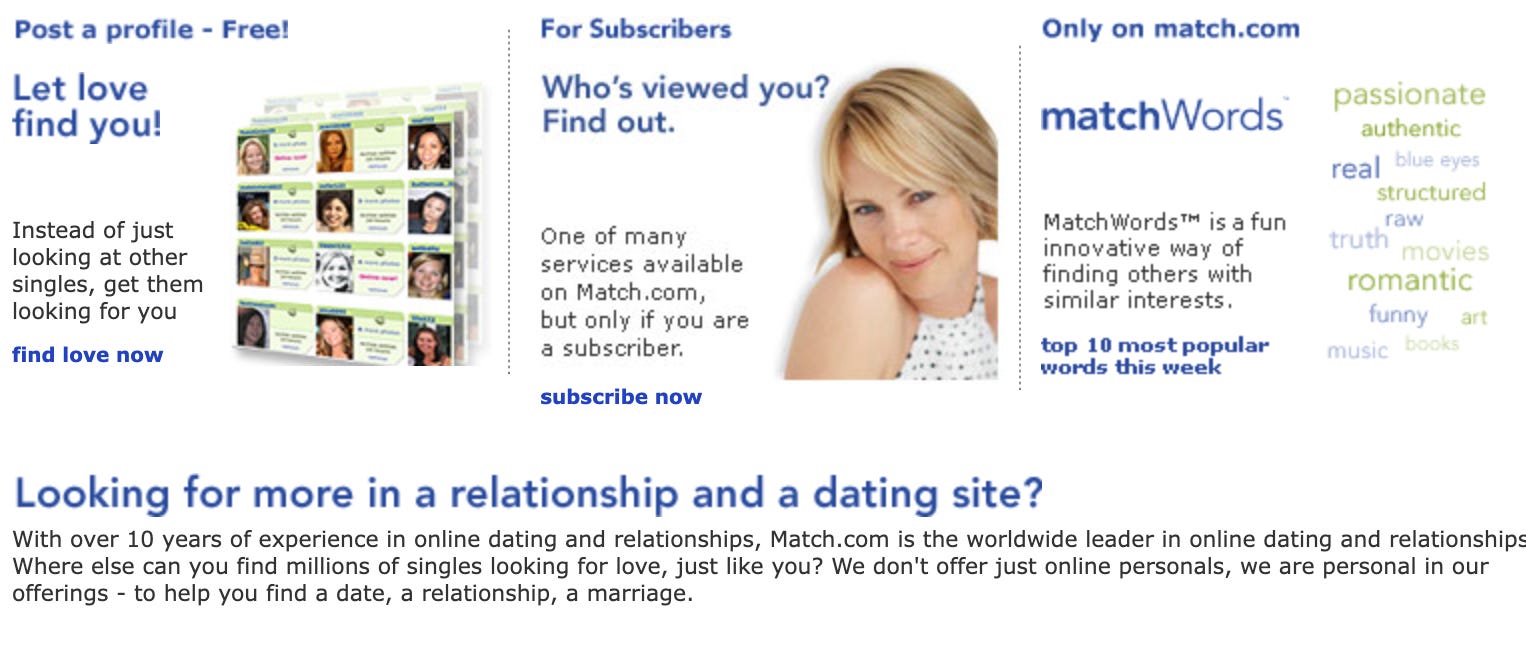
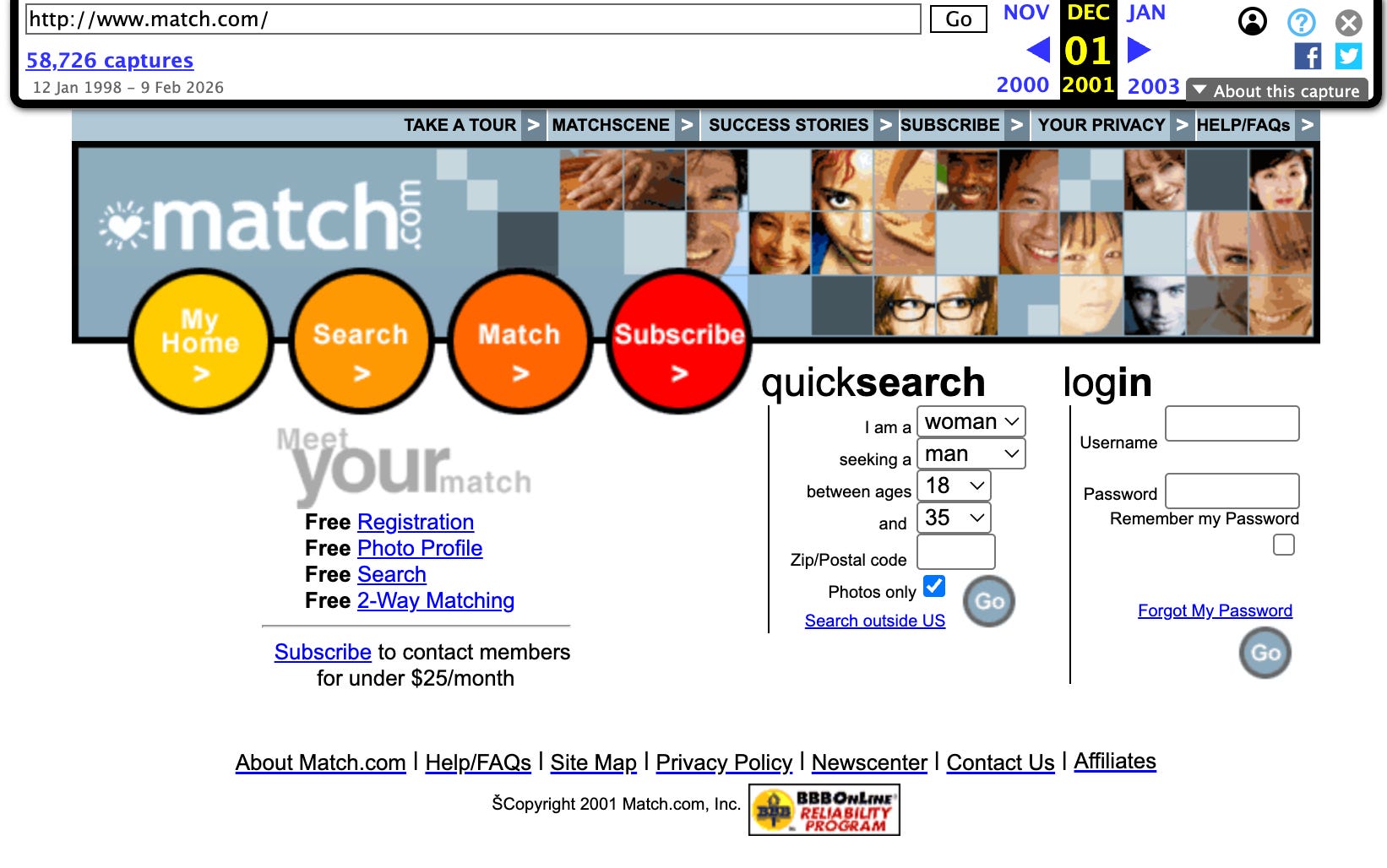
Dating profiles in the early 2000s read like resumes. Photos were so low in resolution, they were only suggestions of what the person looked like.2 You had to actually read someone’s page-long profile to really get an idea of what they’re like. Crazy!
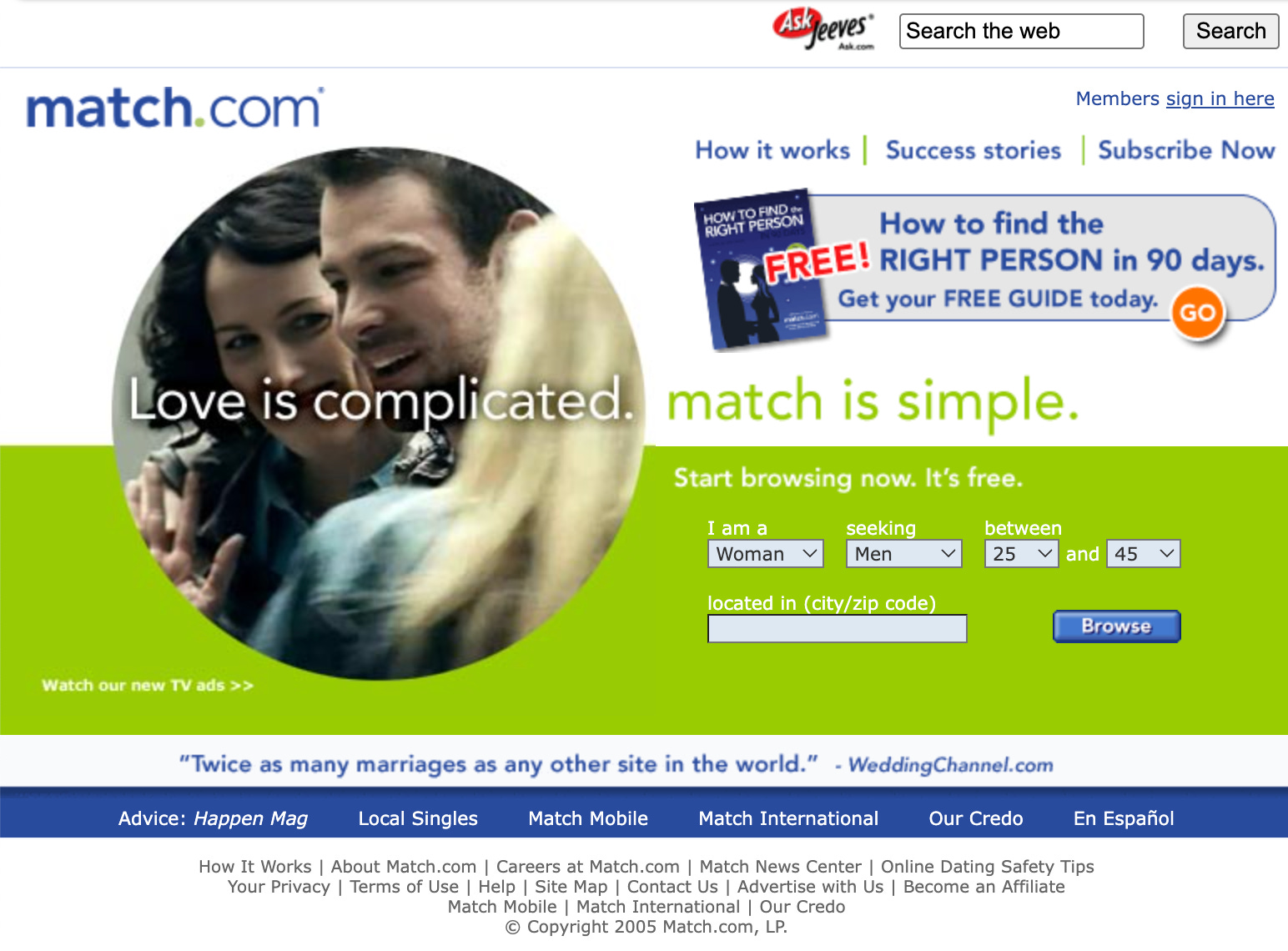
Today, profiles are more pictures than words.3 Prompts are several syllables-long. Our responses are like mating calls: signals, noise, nothing particularly intelligible. There’s a formula to a successful profile: group photos to prove your sociable, tasteful thirst traps sandwiched in between, niche references sprinkled to invite conversation. Even if you weren’t privy to these implicit rules, the ‘Get Feedback’ function on Hinge leverages AI to make sure your profile is up to par. Ah, a well oiled machine.
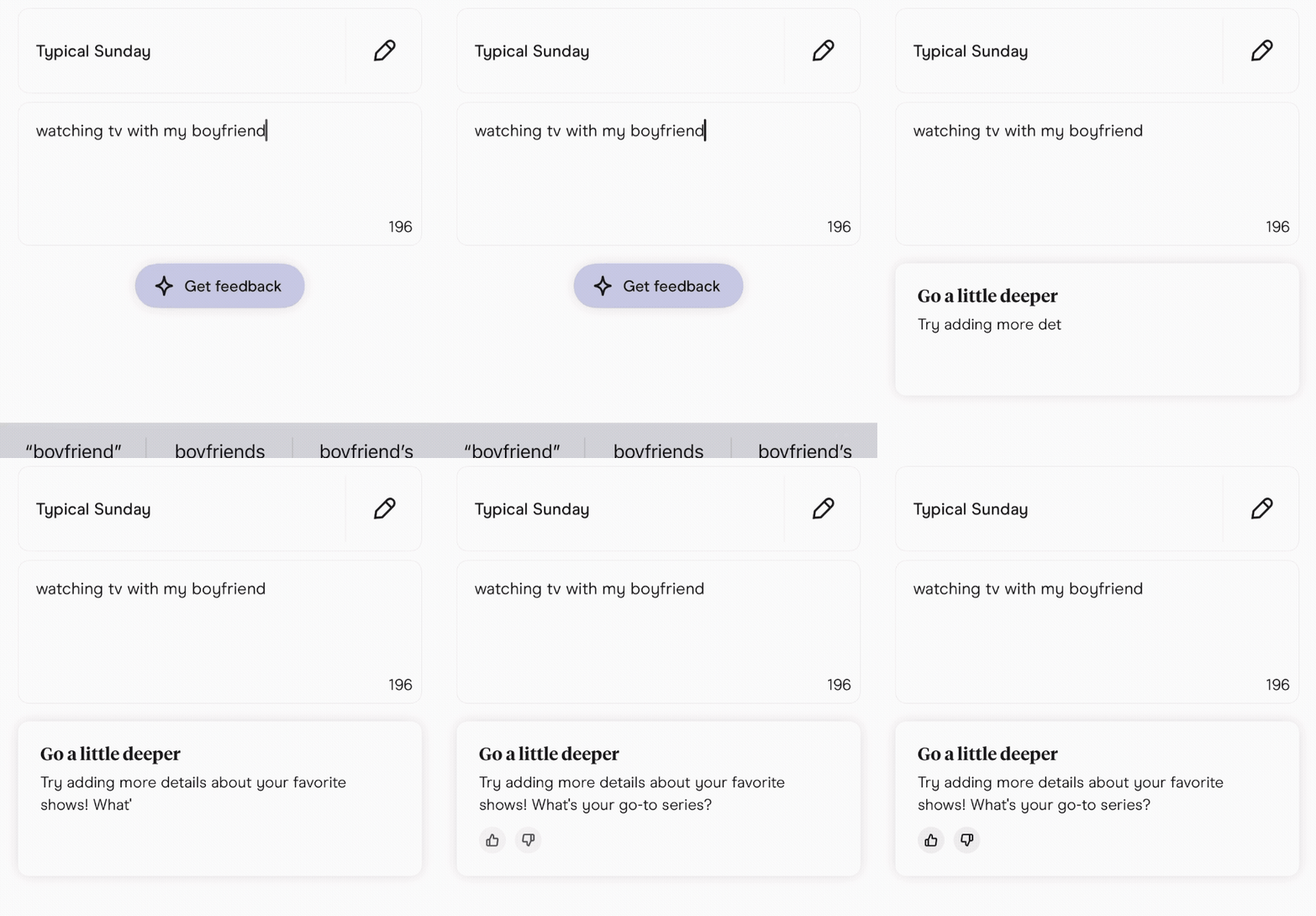
The goal of a profile has shifted
Jeanne-Marie tells me that it was Hal’s prose that piqued her interest (unheard of in this day and age). “His writing was very precise and that meant something to me,” she said. Back then, you wanted to accurately represent who you actually were in your profile because you wanted to attract the right kind of attention.
“If you only say things that you think are interesting to someone else, then they’ll never know what’s interesting to you,” said Hal. Just wait until he sees the references to The Office.
All we want is to be legible
Being knees deep in the era where —according to charli xcx— cool is dead, there’s no longer room to be earnest. We’re all trying to be a version of ourselves. We fixate on performative men and whatever-core is trending. We’ve codified the way we express ourselves in pursuit of being legible: what you’re wearing and where you are in your photos now say more than words. The goal now is to grab someone’s attention not by your interests, but by your capacity to entertain. Audio prompts say it all.
“When they’re trying to entertain, all you can judge them on is performance,” chuckled Hal, as he swiped through my Tinder. I spent a long time debating whether reading a long paragraph on a Hinge profile would give me the ick (maybe I’m the problem). When will it be acceptable again for us to make an honest effort again?
Two wrongs can make a right
Hal remains optimistic. He insists that two people can end up really getting along even if they meet each other for the wrong reasons. “Its the meeting, not the dance,” Hal said, as he ruthlessly swiped left on a dozen profiles.
How to meet someone ‘in the wild’
When I first asked Hal and Jeanne-Marie why online dating appealed to them, they both answered: well, where else?
I was under the impression that, up until a few years ago, dating sites made up only a fraction of how people met. I used to read NYT’s Modern Love religiously, in denial of the slow extinction of meet cutes. I was so sure that everyone else met in the wild —grocery stores, airports, offices. Turns out, meeting someone wasn’t easier just because people didn’t date online. Dating has always been the trenches.
When was the last time you made an in-person move? It’s intimidating, right?
But meeting IRL is still possible.
When Hal and Jeanne-Marie were on OkCupid, online dating was only a supplement, not the whole deal. It felt less consequential because there were alternatives.
Offline, Hal recalled mostly meeting friend of friends. He didn’t frequent bars or clubs but once went out with someone he met at jury duty. Somewhere in between, he took a date from NY to a party in Paris and the whole French atmosphere prompted him to propose (the engagement lasted 2 months). King.
Jeanne-Marie once met someone in Central Park. She found a fanny pack someone had dropped on their run and realized it belonged to a notable creative director in advertising. Eager to make a contact in the industry, she rang the number on the business card to set up a return. “She sounds cute!” the voice who picked up the phone told their boss (owner of the bag). So the two met, dated for 4 years, and remain good friends.
‘Offline’ dating isn’t a lost cause. We now have run clubs, gym crushes, lookalike contests, even game shows to help us out. Dinner parties are making a comeback, too. It easy to treat dating apps like TikTok or Instagram. I, for one, have gone through the cycle of swearing them off then reluctantly re-downloading them (only to see the same pool of people make their rounds). Perhaps online/offline dating isn’t either or…
There’s always been less skin in the game if you meet online
“You’re a lot less committed to someone you meet online,” Hal told me.“If it didn’t work out, I’d just flip a switch and move onto the next one,” he added. Some things never change.
I wonder if online dating feels even more like a numbers game now because of how low-stakes online interactions have become. On more than one occasion, I’ve met interesting people in the so-called ‘wild’ whom I’ve waited to engage with online. It felt safer, reaching out on a platform where you’re both looking for the same thing.4
Could this be our sign to take more risks? shoot more shots?
There will be bad dates!
Technology has enabled such a culture of optimization that we feel the need to do the same with dating. The relentless pursuit of ‘saving time’ spills over to who we choose to spend our time with. There will be sh*t dates! It’s all part of the game!
We’re not perfect. A friend, who shall not be named, once stopped talking to someone because of the way she ate wings. Hal was once taken aback the size of his date’s hands. I once ghosted someone for not knowing who Paul McCartney is (justified). 5
Its so easy to connect with someone online that dating has been gamified
Apparently, the day that your date is scheduled is directly reflective of how enthusiastic your counterpart is about meeting you. Thursdays are best — there’s room for you to reconvene on the weekend. Fridays and Saturdays aren’t ideal (this is prime time real estate you should be sharing with your friends). Mondays and tuesdays are, needless to say, the worst. Some submissions that goes into gorier detail:
Its hard to feel special when access is so abundant.


It’s no secret that the ritual of swiping has reduced us to just stats
The whole premise of the film Materialists (2025) explores what a post-romance world looks like. A world where compatibility is determined by how competitive one is in the ~dating~ marketplace. Height, wealth, looks... Hinge lets you filter through them. Tinder represents them in cute little icons.
We can hate on dating apps for enabling our ‘shallow’ tendencies, but when have we ever not judged a book by its cover?


We’re just variations of a set number of characteristics — 5’2, college-grad, east asian for me. If there’s anything we can takeaway from Celine Song’s admittedly cringe dialogue, is that numbers aren’t everything.
You gotta kiss a couple frogs before you find your prince.
It’s all marketing
Gentle reminder that dating apps are run by publicly traded companies.
When I explained the concept of purchasing Roses and Super Likes to Hal and Jeanne-Marie they paused at first — then their advertising senses kicked in. Of course you can pay more to engage! Of course there are tiers of ‘more viable’ candidates that are held hostage behind a paywall! It is in the interest of these apps to keep you on.
The prices! My god!
In 2008…
Match.com charged $34.99 for 1 month
eHarmony was $110.85 for 3 months ($37/month)
OkCupid was $25 for 1 month
In 2026… there are, shocker, tiers to a membership
Hinge Premium is $34.99/month
Bumble Premium is $29.99–$39.99/month
Tinder Select (the highest tier on the app) is rumored to be $499/month
There’s much more to be said about people who are willing to spend $500 each month on meeting ‘the right person’…
Some advice
So… what now?
When I asked for Hal, he quoted E.B. White’s 1949 essay, Here Is New York: “If you move to New York, you have to be willing to be lucky.”
“I was so lucky to have met Jeanne-Marie,” he added.
Online dating isn’t inherently bad. Had either Hal or Jeanne-Marie not joined OkCupid, it’s safe to say they probably would’ve never met. “The apps are just constant evasion,” Hal sighed. “But that’s not their fault, it’s the app’s fault,” Jeanne-Marie corrected Hal. What matters is how we engage with it.
Dating sites in the early 2000s was a place for you to discover and be discovered. It was a supplement to the delicate dance of meeting interesting people in the wild. Today, dating apps feel like the whole deal — single-word prompts and AI integrations have created an environment for “empirically correct” profiles to thrive.
Eventually, all our profiles will have Instagram face, so here’s a gentle reminder to take more chances on those we see online.
After all, a bad date makes for a fabulous story ;)
Hello! If you’ve made it this far — thank you for joining me on my neo-luddite pilgrimage. If you’d like to support some of my more rogue ventures in cyber celibacy (typewriters, building a printing press… more to come), upgrade to paid! You’ll find treats sprinkled in your inbox <3
Turns out, I had been reading about the AI boom almost exclusively in the context of an increasingly automated workforce and the quick depletion of ponds.
They were often also comically out of date.
The proliferation of Face Tune and beauty filters can also obfuscate what one looks like.
Needless to say, I never found them.
I asked for Hal’s take on ghosting. He said: “that’s just bad manners!”
hmmm we should totally have more experimentation in dating interfaces
this is so good! wonderfully researched and thougtfully put togther, i enjoyed reading it so much. and you are right, we do need to be willing to kiss a couple of frogs, i think we just are so in antipication of the "one" constantly. we aren't willing to do the work really, especially with the supposed ability to be able to connect with everyone on the planet - that one in a billion could be so much closer - so we hesistate to settle down with someone we don't click with instantly.
i met my boyfriend at a party, but i didn't ask him out for three months afterwards, and we've been together over a year now. maybe the first impression wasn't fantastic, or maybe i was just a bit smashed, but i geniunely do believe it's worth going for it and taking that leap of faith.